One of the many regrets of my college years is not enrolling in “The Age of Johnson,” the renowned Walter Jackson Bate’s class on the English Enlightenment. At the time, I found the eighteenth century boring, and believed the tidbits of it I’d studied in English 10, a year-long survey of literature from Beowulf to Virginia Woolf (so went the joke) would suffice.
But the gap in knowledge always bugged me. So, decades later, I decided to give myself a course in the eighteenth century. This year, my reading list included a history of the period, Ritchie Robertson’s The Enlightenment: The Pursuit of Happiness, 1680-1790, as well as a number of key works of literature, including Goethe’s The Sufferings of Young Werther, Boswell’s Life of Samuel Johnson, and a collection of Johnson’s own writings. I saved the most intimidating work of the century for last: Samuel Richardson’s doorstop masterpiece, Clarissa; or, The History of a Young Lady.
I’ve heard Clarissa described as the story of a perfect person surrounded by villains. This conceit, I believe, shortchanges Richardson, reducing his masterpiece to a morality play. While one of his goals in the book was to praise virtue (explicitly Christian virtue), the work itself—like that of other writers in the age of Enlightenment—examines its themes through the depiction of human character as complex, forged and developed through circumstance and exhibited through behavior. The epistolary form Richardson chose for Clarissa is an effective vehicle specifically because it enables him to dwell so deeply on character: as Clarissa and others write their letters, they reveal depths of their personalities that would be less obvious to the reader in a more conventional format.
I prefer to think of Clarissa Harlowe as a tragic hero, and tragic heroes always have tragic flaws. Hers is youthful idealism. Eighteen years old at the start of the novel, and quite sheltered, she has never been tested by the world. For all her talk of being an obedient child, I find no evidence in the book that she has ever obeyed her parents by doing something she was not already inclined to do. In fact, I find no evidence of them having told her to do anything until Solmes comes along and they command her to marry him. What the evidence in the book does support is a sense that Clarissa is spoiled—given everything she wants and praised at every turn. Like many of today’s children, she receives trophies for attendance.
I loved the book, despite its length, though the editor in me longed for a hatchet. At 1,500 very dense pages (an estimated 900,000 words), it’s the longest novel I’ve ever read in a single volume—which, by the way, began to fall apart in the last couple of hundred pages. (In the 18th century, the book was originally published in two volumes.) While the length enables Richardson to delve deeply into his characters, there are long stretches that tried my patience. Basically, I think of Clarissa as a 900-page thriller bookended by two 300-page slogs.
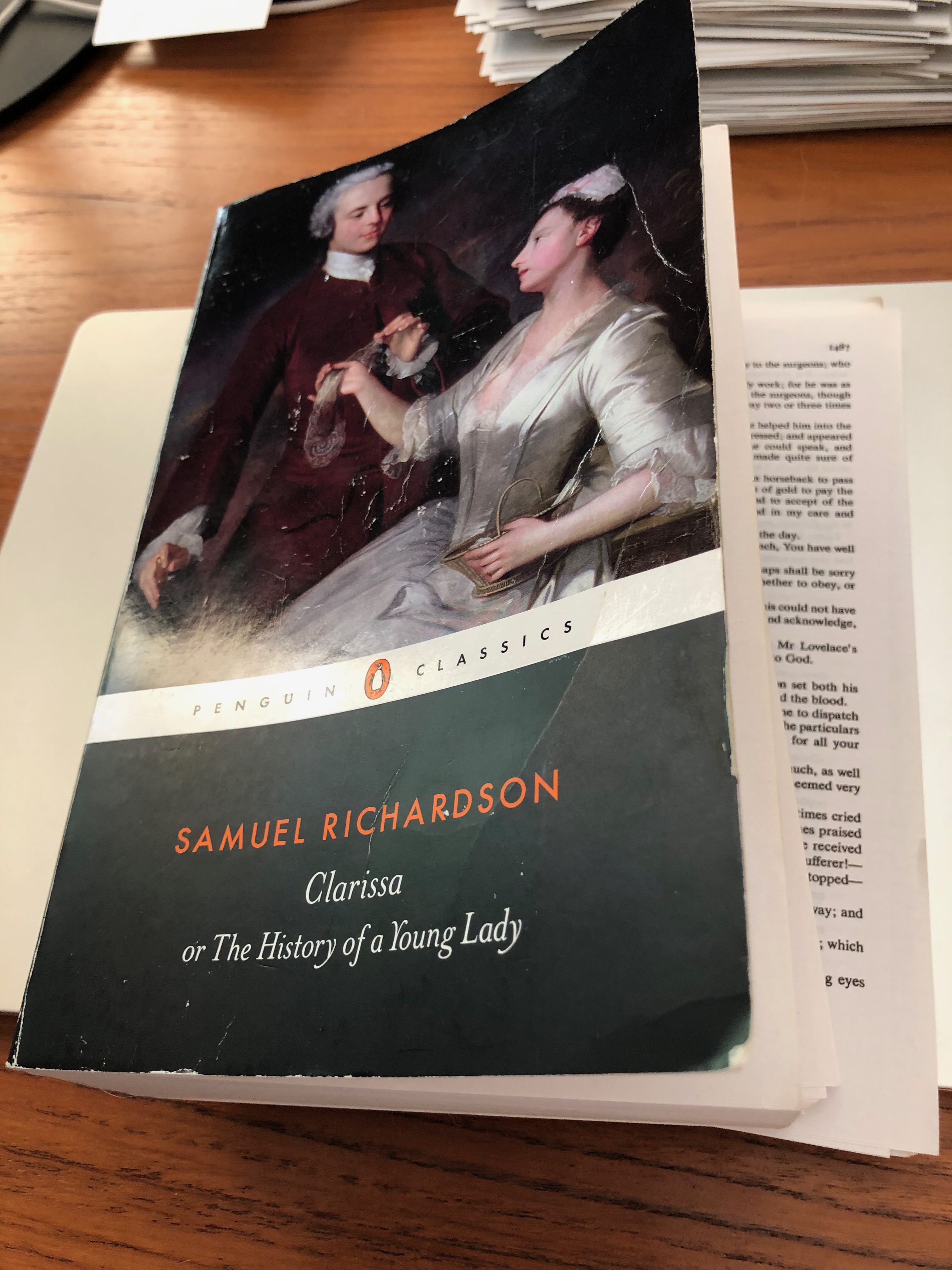
Spoiler alert, in case I haven’t already scared you away from taking this monster on. And if you’re still with me but think this blog is getting too long, please remember that I’m sparing you about 1,495 pages of reading.
Formally, Clarissa is a bildungsroman, examining the heroine’s maturation in three distinct stages.
1) The first section depicts Clarissa’s relentless negotiation with her unyielding family to release her from marrying Solmes, a man she finds repulsive. There’s intransigence on both sides. Clarissa prides herself on being a dutiful daughter, but in this one case (albeit the most significant request she’s ever received), she draws the line. Having been refused nothing before in her life, she’s at a loss.
Of course, forced marriages were the bread and butter of the English novel for two centuries (not to mention all of polite society), but Clarissa takes the theme to another level. For 300 pages, she looks for a way out, but, because she is indeed powerless, she can offer only a passive-aggressive response: request more time (hoping her parents will relent), and then reiterate the same arguments again and again (hoping to exhaust them by a thousand cuts). This is not to say that she doesn’t have a point. Solmes is clearly a fool, but many a novel has been written about the tragedy of women forced to marry fools.
Her parents, of course, never believe her argument that she doesn’t want to marry at all. They’re convinced that she’s rejecting Solmes merely because she’s in love with the libertine Robert Lovelace. Although she is attracted to him, marriage is clearly not her objective (nor is sex). Lovelace, however, is the only person in her world willing to help her escape from Solmes. Even if he’s doing it solely for his own nefarious reasons, no one else steps up to the plate. Thus, when she’s in a particularly vulnerable moment, he tricks her into running away with him.
Convinced that Clarissa has gone off with Lovelace deliberately, her family disown her. They tell themselves that she deserves whatever she gets, and refuse to offer any help or even to communicate with her until it’s too late.
2) Now the thriller begins. Lovelace’s motives, for all his avowals of love for Clarissa, are primarily sexual. He imprisons her in a high-class bordello, restricting her movements under the guise of protecting her from being kidnapped back by her family. Lots of drama ensues, particularly as Clarissa contrives her escape from him, followed by his trickery to get her back, after which he drugs and rapes her.
It’s during this long stretch of the novel that Clarissa grows as a character, developing and revealing an inner strength that seemed inaccessible in the first section. She fights back at Lovelace, verbally and physically, as she begins to understand and own who she really is beneath the fine clothes and beyond the placid confines of her parents’ home.
The drama of this portion of the novel also benefits from a structural choice. While the first section is told mostly in Clarissa’s voice, through letters to her best friend, Anna Howe, Richardson switches gears once she’s free of her parents and gives the bulk of the narration to Lovelace, through letters to his friend Belford. And Lovelace, as a worldly man and a lusty one, has a much more dramatic and engaging style. Even as the reader is horrified by his duplicity and cruelty, you can’t help being riveted by his storytelling power. He’s charming, funny, and more than a bit deluded, characteristics that combine for a great read.
3) Once Clarissa escapes again, after the rape, she shows signs of building an independent life. But another incident (not of Lovelace’s making) breaks her spirit at last, and she then spends 150 pages “dying of grief” (that’s apparently how heroines succumbed before consumption). From a modern sensibility, of course, this is hogwash. What Clarissa has is depression, and she’s effectively killing herself by not eating properly.
It’s in this period that Clarissa reaches her apotheosis. In a typical bildungsroman, the hero would now embark upon a new phase of life, invigorated by the sense of self and strength developed through calamity. Think Jane Eyre after the fire, or Brunnhilde before hers.
Where Clarissa used to be called a “perfect creature” by one and all, the terminology now shifts more and more to “angel.” Broken by the real world, she turns to the supernatural. She lives for God and longs for the afterlife, endless trips to church her only reason for leaving the house.
At this point, of course, I got seriously frustrated with her and what feels like regressive behavior. She’s back to the old Clarissa, the one before she grew a spine, the one who is simply too good for this world. If she had only taken as much responsibility for her life as she now does for her death (going so far as to purchase her own coffin and place it melodramatically beside her bed), the story would end in a very different way.
But maybe she really doesn’t belong in the material world. That seems to be what Richardson wants us to believe—that Clarissa is a spirit who happened to take human form for nineteen years. After all, he does fill this last section with an awful lot of Christ imagery.
Thus, the bildungsroman culminates not in adulthood, but in death. After the 150 pages of dying follow the 150 pages of survivors grieving for her and realizing their own roles in her tragedy, concluding in a duel between her cousin and Lovelace, in which the villain (I’d say antihero) finally succumbs. Lovelace’s regret and sense of guilt are powerful in this section, and one of his letters in particular is my favorite part of the entire novel.
The psychology of the book overall is impressively complex, suggesting the insights more commonly found in a twentieth-century novel. Lovelace, I think, is Richardson’s most brilliant creation. He is torn in painfully real ways: Part of him knows what an ass he is and recognizes that his treatment of Clarissa was unforgivable. But there’s also a part that truly loves her. He wants to blame her family, or even Clarissa herself, and to think that his pain is worse than any of theirs. (I told you he was deluded.) When he goes off to the continent near the end of the book and begins to feel himself again—joyful, strong, perhaps even rakish—he’s really hiding the truth, the guilt that’s destroying him. And there are distinct hints in the duel scene that he takes a suicidal dive.
It’s always risky to read classic literature through a modern lens, but I think it behooves us to hold both sensibilities at once. Great literature is immortal not just because it depicts its historical period well, but because it enables us to see that the human condition is constant.
For me, the great tragedy of Clarissa is a common one: the disconnect between individual sensibilities and social dictates. The economics of the time led women to be treated as property to change hands, from father to husband, in the furtherance of wealth. This notion was supported by religious injunctions against sexual pleasure. A bride had to be a virgin, or she was “ruined.” And a man, less able and less encouraged to repress his sex drive, lived in sexual frustration until marriage (and probably after), save for the help of “loose women.” (The bordello in the novel, where women are rented out, feels almost tame compared to the outside world, in which they’re sold.)
Clarissa epitomizes the denial of human nature at the heart of the religion of its time (and most of the religion of our own). The heroine seems less traumatized by the violence done to her body than by the dishonor done to her “soul.” Unable to accept that her body, as the temple of that soul, has been defiled, she chooses to jump over the rest of her life and head straight for heaven instead. The depression that leads her to this fate is a mental illness, and her faith a mechanism for passive suicide. She contemplates active suicide, but rejects it as a sin. What, I am left to ask, is the difference?
Yes, Clarissa is a victim of other people and of her society. But equally implicated in her tragedy is her inability to let go of her idealism. When she’s on the verge of finally being done with Lovelace, she learns that she isn’t as independently minded as she always thought. She convinces herself that she has sinned by allowing Lovelace to take her away from her family and that she must pay the price for that lapse in filial duty. If she were a little older and a bit more worldly, she might see another way out. But, like most people her age, in any time, she thinks she already has all the answers, and that is her downfall.
Throughout the book, I found myself wondering how reliable these narrators were. Through their letters to their respective friends, we learn that Lovelace and Clarissa routinely lie to each other. In addition, they occasionally hide certain truths from their correspondents, but I think they reserve the biggest lies for themselves. Midway through the book, Anna tells Clarissa, “I do know you love him,” and the statement comes as a revelation to the reader. After all, Anna knows her better than we do. The most Clarissa subsequently admits, when pressed, is that she “could have” loved Lovelace if he hadn’t been so brutal to her. The depth of her initial feelings thus remains a mystery, but Anna’s remark made me read more carefully, looking for hints of something more.
One of the novel’s most disturbing issues is the notion (repeated by several characters) that the solution to Clarissa’s dishonor would be to marry her rapist. In other words, she’s spoiled goods, and the only way to undo that is to have Lovelace make an honest woman of her, since no one else would want to. Clarissa herself contemplates this option, and much of the drama in the middle portion of the book concerns Lovelace’s deceiving her into believing their marriage would reconcile her to her family. Throughout the second half of the novel, in fact, Clarissa and many of the other characters go back and forth on the question, at times advocating it, at others dismissing it.
Indecision, after all, is at the core of the novel’s drama. If Clarissa could make up her mind, her story could be told in a few hundred pages. Part of Richardson’s genius is his willingness to harbor complexity and ambiguity. Lovelace performs villainous acts, but he also has noble qualities, and an emotional core that he fears and can’t fully access until forced to face the consequences of his behavior. In a mirror image, Clarissa is a gentle and pure soul, but she also has access to strengths she is unsure how to use. Human character, Richardson shows us, is complex and untidy. Sometimes we can’t even understand ourselves, let alone anyone else.
I wonder how I would have reacted to this book if I had read it in college, when I was closer to Clarissa’s own age. From the perspective of midlife, it’s easy to find fault with Clarissa’s stubbornness and devotion to an idealism that ultimately destroys her. But if I cast myself back in time, I see an early adulthood riddled with errors and near-misses. At Clarissa’s age, we all think we know better, we all think the world is as simple as our circumscribed experience suggests. For me, Clarissa is both an object lesson and a reminder that youthful idealism, for all its dangers and annoyances, is key to the forging of character. There’s a tragedy in succumbing to it, but the greater tragedy may be in losing it to the dull practicality of maturity.
 Lewis DeSimone