I just returned from the annual Saints and Sinners Literary Festival in New Orleans. It was my first time there since the pandemic, so it felt a bit like a homecoming. The weekend was full of thought-provoking panels, inspiring readings, and the joy of community.
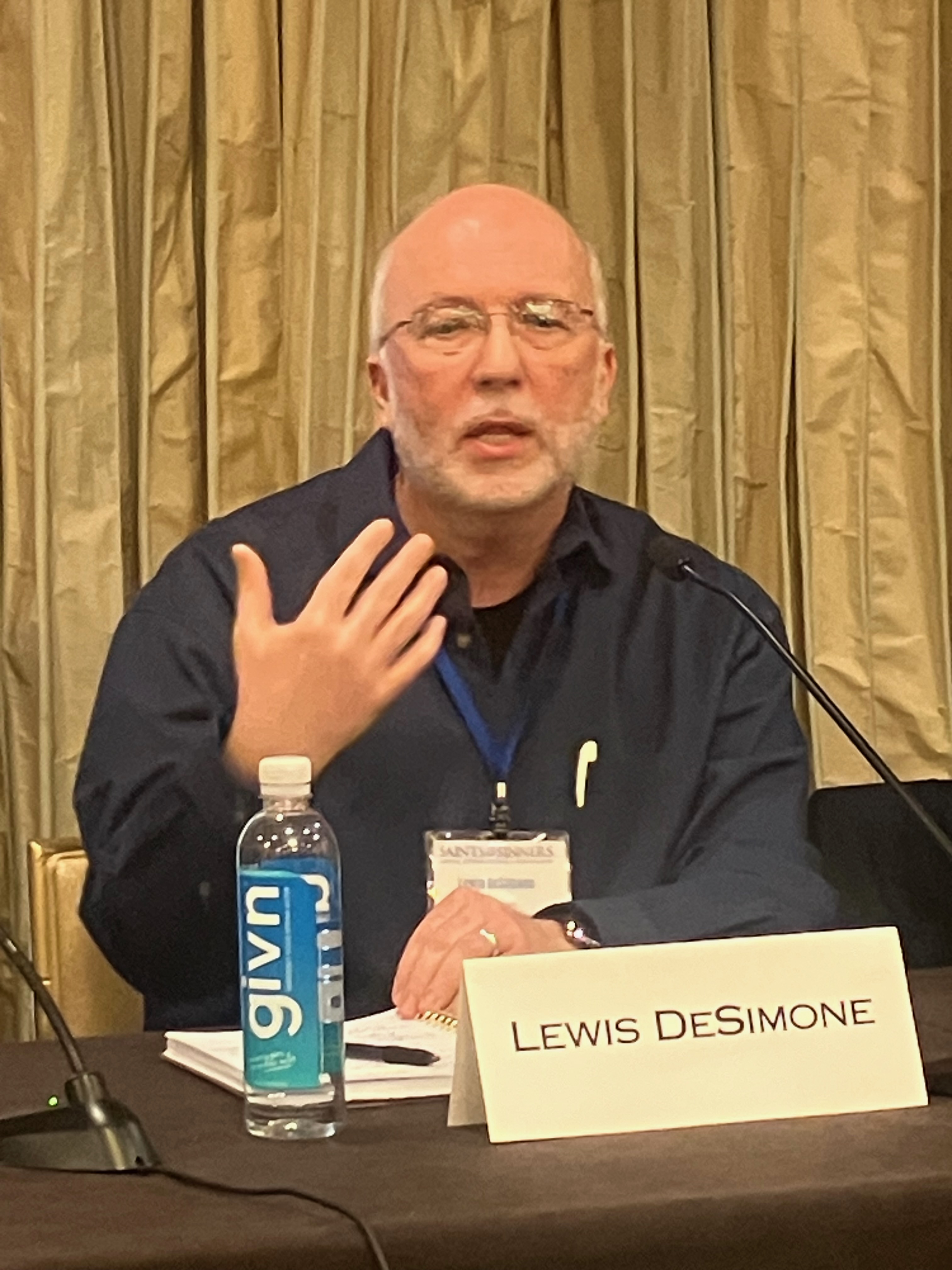
Sharing words of wisdom at the panel on Generational Change in Gay Culture and Literature
As always, the festival offered opportunities not only to reconvene with old friends but to make new ones. Writing, of course, is by definition a lonely activity, and it’s also a widely misunderstood one. That fact was underscored for me by an incident at the hotel bar the day before the festival officially began.
A few stools down from me, a thirtyish man was networking to his heart’s content, chatting up the bartender and other patrons, telling each one about his new law practice. He was looking for leads to build up his client base. When a middle-aged woman took the seat beside him, he launched into his spiel and asked what she was doing in town. She told him she was a writer attending the festival. He grew excited and took the opportunity to ask her what sort of work her attorney did for her. She laughed and said she didn’t have an attorney. This he could not fathom. “You’re a writer and you don’t have a lawyer?” “Believe me,” she said, “with the amount of money I make from my books, it wouldn’t be worth a lawyer’s time.”
The conversation encapsulated the misperceptions writers face in the world and why we need our own community for sustenance. At the festival, I was surrounded by people who got it, who understood that the majority of us will never make a living from our writing. They understood that the pleasure of creativity is our primary motivation. Some people write to make money, but the majority of us write out of love.
And for the weekend, we came together as a tribe—commiserating about our challenges, sharing tips on publishing and promotion, honoring one another’s efforts. And most of all, encouraging our peers to keep going.
I came away with a renewed commitment to my work. I even found inspiration for a major development in a piece I’ve been struggling with for ages. Such is the power of community in the creative process.
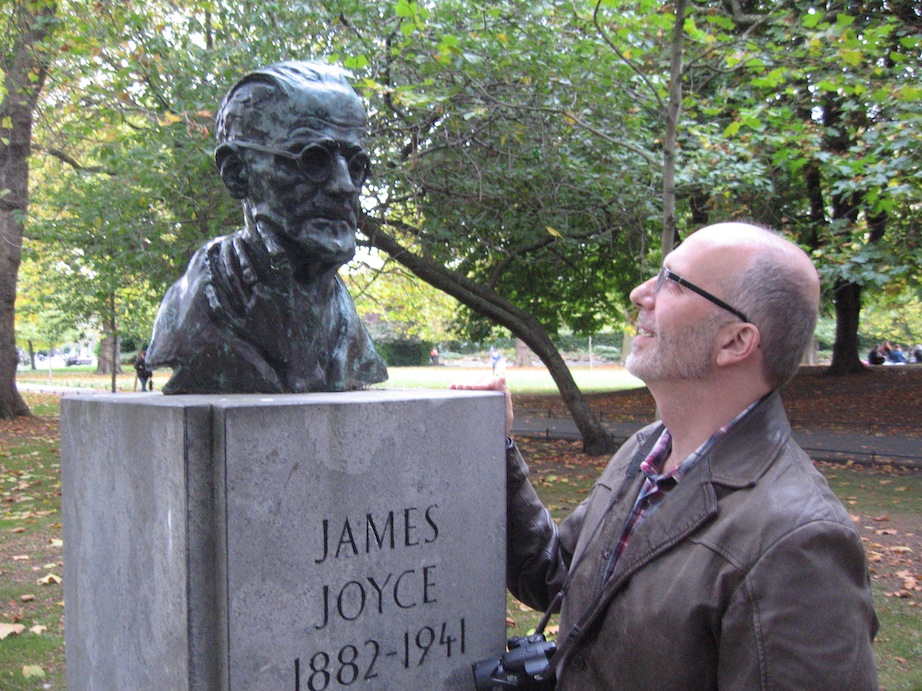
Bucket lists are pretty individual things. While other people want to skydive or bungee-jump before they kick the proverbial, I’ve chosen less foolhardy things: Learn French. Visit Stonehenge. Read Finnegans Wake.
What, you say? Is it a bucket list or a self-torture device?
I’d say the same about skydiving. There’s no accounting for tastes, or definitions of foolhardy.
I fell in love with James Joyce way back in college, when my junior tutorial focused on Dubliners, A Portrait of the Artist as a Young Man, and Ulysses. At the time, Ulysses seemed a herculean task—and, faith and begorra, it was—but I somehow knew that my voyage into Joyceana would not be complete without reading his final book, purported to be the most difficult in the English language.
Spoiler alert: it is.
Where do I start? Perhaps in the middle of a sentence? (See below.) I’d waited years to read Finnegans Wake; only once I’d retired did I think I’d have enough free to time to give it the attention it would need. I ended up reading it fairly quickly, though—a chapter a day except for the longest couple, to which I dedicated two days each. That schedule required about two hours with the Wake per day, plus another hour for the reader’s guide by William York Tindall.
The most important decision I made was to be gentle with myself. Even Joyce scholars—including Tindall—do not claim to understand the whole thing. It’s simply too dense. Consider this: It took Joyce 17 years to write a 600-page book. That means he was writing at the rate of one-tenth of a page per day. Every word is impeccably chosen. Every word holds multiple resonances, including a plethora of delicious puns (“Ourh Former who erred in having”; “with my bawdy did I her whorsip”) and portmanteau words (“humptyhillhead”; “middayevil”). Nothing is straightforward. The language itself pulses with life in every sentence.
I chose to let the language wash over me rather than trying to pick apart every sentence. To make it easier, I found an audio version of the book and followed along with the reader—to keep me from stumbling over words and to bring the text more to life. The primary reader, Irish actor Barry McGovern, modulated his tone to represent different voices (often, there’s dialogue within a single paragraph, unmarked) and also enlivened the text with various Irish accents as appropriate. Marcella Riordan also appears in a couple of chapters, with a lively take on the female characters. I don’t know if I could have finished the book without them.
If Ulysses is the story of a single day, then Finnegans Wake is the story of a single night—most of it narrated in a dreamlike state. There are major characters—H.C. Earwicker, Anna Livia, and their children—but they tend to blend together at various times. In the end, they’re less individuals than arbitrary representatives of humanity. And the plot is ultimately unimportant. This is a story about cycles (starting with the final sentence, which merges back into the first)—wakefulness to sleep to wakefulness; life to death to life. The place where this theme resonated best for me is a sex scene in Chapter 16 (“For they met and mated and bedded and buckled and got and gave and reared and raised…”), in which the coupling of two individuals yields not just a child, but all of history; life, whether individual or communal, starts in a bed and is continually renewed there.
Throughout the book, Joyce jabs at literary history and criticism. He toys with the reader, making the text deliberately impenetrable, as though relishing the image of critics twisting themselves into pretzels trying to understand it.
I can’t say I understand the Wake, but by the end, I did feel that I “got” it. I fell into the rhythm of it, as if I were part of Earwicker’s dream. Which may be the point. One of his nicknames is Here Comes Everybody. No doubt, Joyce intended us all to see ourselves in the Wake. As a dream book, it dwells in the depths of the soul, the primordial soup of the subconscious, the foundation of humanity.
It’s also one of the funniest books I’ve ever read. The puns alone are worth its heft. In all honesty, I haven’t laughed aloud so much with a book since John Kennedy Toole’s A Confederacy of Dunces.
 Lewis DeSimone