To Be Real

I’m currently working on a novel that has its roots in my own life. Other books have borrowed the enamel and the cavities; this one requires a full-on root canal. It’s a book I’ve been living with for years now. At first I tried prettying up the story—making the characters nicer, richer, more articulate than the real people who inspired them. But the heart was missing, so I began stripping away the artifice. After many attempts, I finally think I’m onto something. The story is now more grounded in the reality of the world I lived in at the time, and how I felt about it. But I’m still manipulating the events, the timeframe, the nuances of the characters. It’s still a novel. I believe that fiction more easily gets to the truth—emotional, spiritual truth—than memoir (which is always imperfect, anyway, and therefore not as honest as it claims).

In the midst of my angst over the book, my attempt to harness real events into a constructed universe, I stumbled upon a cautionary tale about the pitfalls of straddling the line between fiction and history.

The recent film Roofman is distinguished by its cast: a charming and emotionally complex Channing Tatum, a hilarious Juno Temple, a deliciously wicked Peter Dinklage, and an absolutely brilliant, Meryl Streep-channeling Kirsten Dunst. These performances are all the more remarkable because the actors rise so far above the material they’ve been given.

The filmmakers constructed an entertaining and suspenseful comedy that keeps the viewer riveted for more than an hour. But then reality intervenes. Literally.

Because Roofman is based on a “true story,” the filmmakers set themselves an impossible task. The movie it seems they wanted to make is the story of a loser with a heart of gold who gets tempted toward criminality because of a desperate desire to win back his family. So far, so good.

But as Jeff’s world  begins to crumble, darkness creeps in. His desperation leads to increasingly violent moves. Whereas he began his life of crime by robbing McDonald’s outlets and playing a soft-spoken Hamburglar—making sure his victims all had coats before locking them in the freezer—by the end of the movie he’s pistol-whipping a guy and setting a business on fire. Over the closing credits, we learn that the real Jeffrey Manchester may not have been quite the charmer Tatum makes us fall in love with. His crimes were more extensive, and the film takes significant liberties with the order and circumstances of his spree.

And there’s the rub. The ending seems to be something out of the old Hays Code, where the character, no matter how charming or sympathetic, must be punished for straying from the straight and narrow.

The real problem, though, is that the filmmakers can’t decide how much reality to use. So they opt for a schizophrenic movie that destroys the verisimilitude of its central character. Tatum as Jeff is a charming criminal from the get-go; but in the latter half, that charming guy starts putting people’s lives and livelihoods in danger, and there’s no sufficient motivation to explain the change in his moral compass. Sadly, Tatum has invested so much in making us like the guy that he can’t believably go to a dark side, so the audience is torn between rooting for a hapless man and wanting him to get his comeuppance. (I for one just wanted him to be smarter. There’s a key moment near the end when he seems to miss that he’s being set up.) What’s really happening is akin to Jeff Daniels’s dilemma in The Purple Rose of Cairo: a fictional character steps out of the screen and becomes a real human being, a role he seems constitutionally unfit to play.

Roofman might simply have used the disclaimer “inspired by a true story” and gone off on a different tangent—changing names and locations along with the plotline. Instead, the filmmakers seem to have fallen into the trap of trying to please a public that increasingly finds “reality” somehow more compelling than well-made fiction.

Whether docudramas or memoirs, I always find myself wondering why so many people seem to think that a story that “really” happened is inherently worthier of attention than one that’s completely made up. Not that fiction is ever completely made up; it always contains elements of the real experience of the creator and the world around him or her (the enamel if not the root).

Roofman’s problem is of a different sort. Stories—and especially characters—should be internally consistent, no matter the source material. My research suggests that the plot that triggers the climax of the film (Jeff’s need for money to finance his plot to leave the country) was invented by the filmmakers, perhaps as a way to explain the violence of his final robbery. (The film also places his act of arson in this period, though it was actually committed long beforehand.) They must have thought they were solving the problem of the plot. But in the process, they deconstructed the protagonist—who was the very hook for the story to begin with.

If you want to enjoy this movie, I recommend forgetting that it has any connection to reality. And focus your attention instead on Kirsten Dunst’s transcendent performance.
Building Community

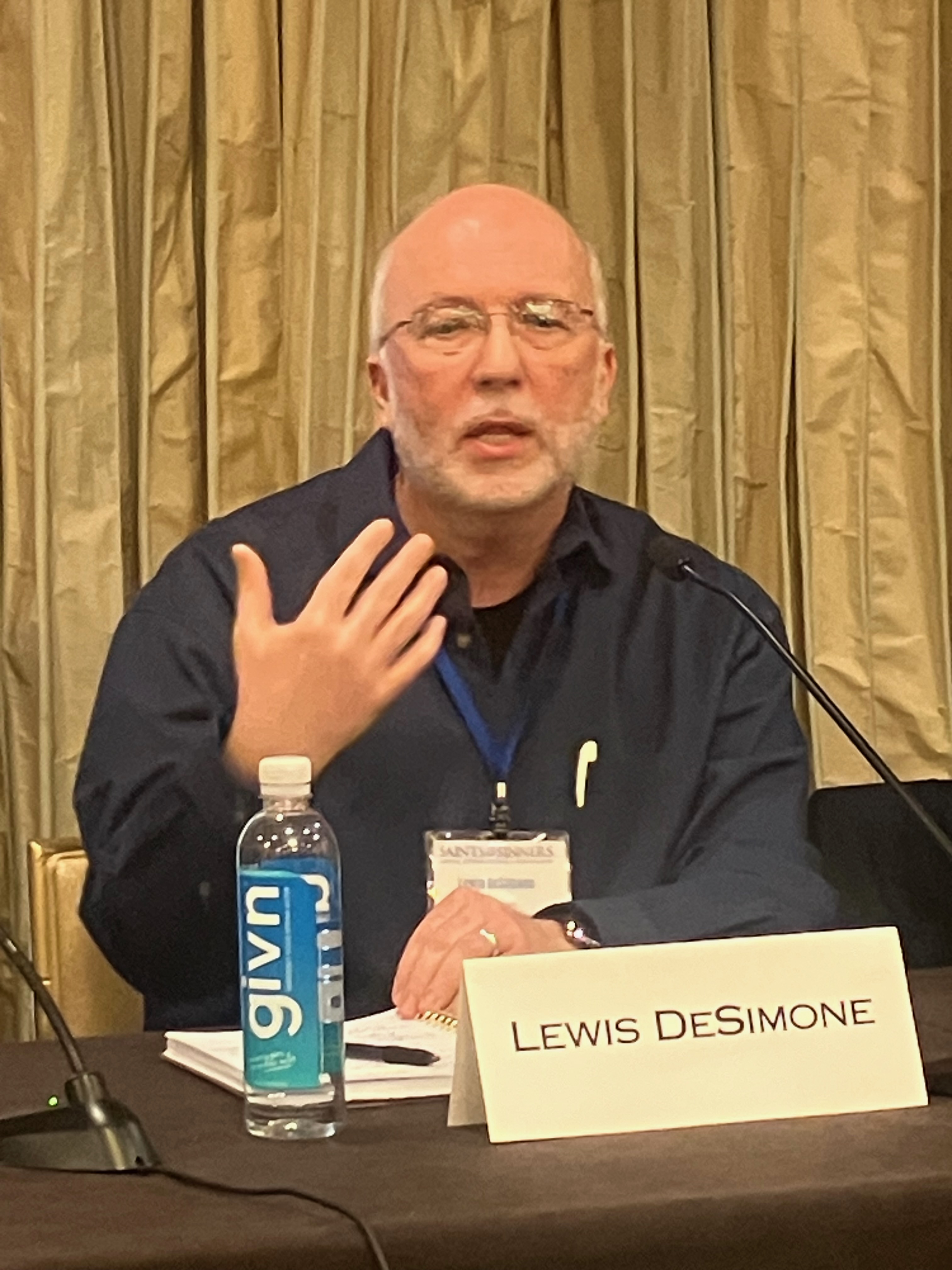
I just returned from the annual Saints and Sinners Literary Festival in New Orleans. It was my first time there since the pandemic, so it felt a bit like a homecoming. The weekend was full of thought-provoking panels, inspiring readings, and the joy of community.

Sharing words of wisdom at the panel on Generational Change in Gay Culture and Literature

As always, the festival offered opportunities not only to reconvene with old friends but to make new ones. Writing, of course, is by definition a lonely activity, and it’s also a widely misunderstood one. That fact was underscored for me by an incident at the hotel bar the day before the festival officially began.

A few stools down from me, a thirtyish man was networking to his heart’s content, chatting up the bartender and other patrons, telling each one about his new law practice. He was looking for leads to build up his client base. When a middle-aged woman took the seat beside him, he launched into his spiel and asked what she was doing in town. She told him she was a writer attending the festival. He grew excited and took the opportunity to ask her what sort of work her attorney did for her. She laughed and said she didn’t have an attorney. This he could not fathom. “You’re a writer and you don’t have a lawyer?” “Believe me,” she said, “with the amount of money I make from my books, it wouldn’t be worth a lawyer’s time.”

The conversation encapsulated the misperceptions writers face in the world and why we need our own community for sustenance. At the festival, I was surrounded by people who got it, who understood that the majority of us will never make a living from our writing. They understood that the pleasure of creativity is our primary motivation. Some people write to make money, but the majority of us write out of love.

And for the weekend, we came together as a tribe—commiserating about our challenges, sharing tips on publishing and promotion, honoring one another’s efforts. And most of all, encouraging our peers to keep going.

I came away with a renewed commitment to my work. I even found inspiration for a major development in a piece I’ve been struggling with for ages. Such is the power of community in the creative process.

First-Person Problems

Many years ago, I was waiting for a friend in the lobby of the New York City Opera when a passing lady mistook me for the famous bass-baritone Samuel Ramey.

Well, actually, that’s not entirely true. The woman approached and told me I looked like Mr. Ramey. I shook my head with a flattered smile, and said she was mistaken. “No,” she said archly, “I didn’t think you were Samuel Ramey. I just said you looked like him.”

There’s a big difference between being someone and being similar to him. So, in that spirit, let me state clearly that I am not Craig Amundsen. I just play him in a book.

Craig is the first-person narrator of Exit Wounds, my recent novel. Like the book, he is a work of fiction. But try telling that to some of my readers:

“I love the scene where you dump your boyfriend.” (While I’ve dumped a boyfriend or two, it never happened the way it does in the book.)

“I felt so bad when you lost your job.” (I never worked in a bookstore, let alone was laid off from one.)

I suppose I should take it as a compliment. Perhaps the assumption that Craig is really me is evidence that he comes across as an authentic person and not just a cardboard cut-out. Nevertheless, there’s something creepy about being mistaken for an imaginary being.

These comments, of course, have so far come from friends, people who know me well enough to catch some of the true-to-life references in the book and to imagine me in the role of Craig or any of my other narrators. But I do have to wonder what other people think: Do all readers assume that a first-person narrator is a stand-in for the author? That Melville was in a shipwreck and floated to safety on a coffin? That Charlotte Brontë’s boss kept his wife in the attic? That Nabokov was a pedophile?

Every book has a narrator, of course; the third-person kind just gets to slide by unnoticed. It’s still a person, and may even be a character observing the story. It’s not always a god looking down as she manipulates her hapless characters. But if she communicates the story to you as an I, a personal bond is forged between narrator and reader (spoiler alert: this is often precisely what the writer is hoping for).

Perhaps contemporary readers are more likely to mistake the narrator for the author because of the dominance of memoir in the market these days. Readers are told to believe that everything in a memoir is factual (even dialogue and detailed memories from childhood), so they may have a Pavlovian reaction: if you see an I, then automatically believe what it says.

The truth is that no book is or can be a perfect representation of real life. No matter how much the story or character has in common with the author, nearly everything is modified in some way—for clarity, to elucidate a theme, or “to protect the innocent,” as they used to say on Dragnet. I would posit that this process is no less common in the highly problematic genre of memoir, but that’s a subject for another time.

It always seems to come down to the crucial difference between fact (what happened) and truth (what it means): writers should be primarily concerned with the latter. When necessary, we use fact to illustrate that truth—but still, everything is filtered through the imagination.

So yes, some of the events in my work are based on my own experience. Some of the characters’ personalities (narrator or not) are inspired by mine. Like Craig, I lived in the Castro for many years and served as a juror on a case much like his. But I never ran a bookstore, I didn’t go to Stanford, and I’m not from the Midwest. On the other hand, I’ve spent a lot of time in bookstores; I’ve visited Stanford; and I moved to Minnesota in my fifties. All those things helped me paint a picture of Craig’s life, but his lived experience is not mine. No more than Samuel Ramey’s marvelous voice.