Normandy and Charlottesville

I’ve never been one for skydiving or red convertibles, the cliché signs of a midlife crisis. My confrontation with mortality tends instead to lead to a less dangerous bucket list, one that’s focused primarily on places I have yet to visit—the Grand Canyon, Stonehenge, northern Norway for a front-row seat at the aurora borealis.

I recently checked off one of the spots near the top of my list: Normandy. My father fought in World War II and arrived in France a few days after D-Day (thus significantly increasing the chances that I would exist to be writing this today). He never spoke much about the war, so I got a better idea about what battle is like from Steven Spielberg than from him. In 1945, when it was all over, he was just 25 years old, and already battered by more trauma than I hope to know in a lifetime. I wouldn’t want to relive that much, either.

He’s been gone for a while now, but I wish I could tell him what it was like to step onto Omaha Beach 73 years after he did. The most remarkable thing is that it looks like a beach—just a beach. I don’t know exactly what I was expecting—angels hovering over the water, perhaps, or a John Williams score blaring from the clouds. Instead, I found a surprisingly narrow strip of sand, with children playing on it.

There’s a monument, of course, Allied flags still waving from tall poles, and a modern sculpture that looks like wings emerging from the sand. But what moved me most was the expanse of the place. Beyond the sand, there are grassy fields, a road, storefronts, all on a flat stretch of land far from the hills upon which the Germans roosted on that fateful, fatal day. That openness, and the placidity of the place, gave me a shudder. The only phrase that came to mind was another cliché, both inadequate and inevitable: sitting ducks. When the hatches opened and the Allied soldiers emerged into hellfire, there was nowhere to hide.

But ducks don’t know they’re sitting. Those men knew exactly what was about to happen. And still they did it. They did it simply because it had to be done, because there was no living without freedom. They did it not for themselves—they all must have feared they’d be dead within minutes—but for us.

Later, we visited the American Cemetery, a beautiful, cliffside lawn where nearly 10,000 people are buried. It’s a sea of white crosses and stars of David, all facing westward, toward home.

I walked slowly, as reverently as an atheist can, through the rows of graves. And I found myself lightly touching each marker I passed and murmuring, Thank you. Thank you for putting principle over personal safety. Thank you for standing up to tyranny. Thank you for making the world a better place for the rest of us.

We were on vacation, and—especially these days—vacation means an escape from the news. I didn’t watch any television that week, barely checked the headlines on the rare occasions when I bothered to log in to Wi-Fi. But I carried the news with me. I carried the trauma that has haunted me since November 2016. I carried the knowledge that the country I was visiting, the one that had capitulated to Hitler, had soundly rejected protofascism in its own recent election, while ours—the country that had saved it—had gone the other way. And I carried the memory of Charlottesville, where a woman had been killed fighting against the same kind of hatred that had started the war this hallowed ground acknowledged. Just days before, fascists and white supremacists had marched through the streets of Charlottesville, torches in hand, proclaiming hatred for anyone who didn’t look like them. And, as I came to learn while I was across the sea, the president of the United States had refused to condemn them.

The markers in that cemetery are a tribute to the brave Americans who stood up to barbarians and sacrificed their lives for freedom. Those people did not die so that the president of the United States could pander to Nazis. They demonstrated bravery in the face of death, not cowardice in the face of poll numbers. If our current commander-in-chief set foot on that sacred spot overlooking Omaha Beach, the very ground would tremble in protest.
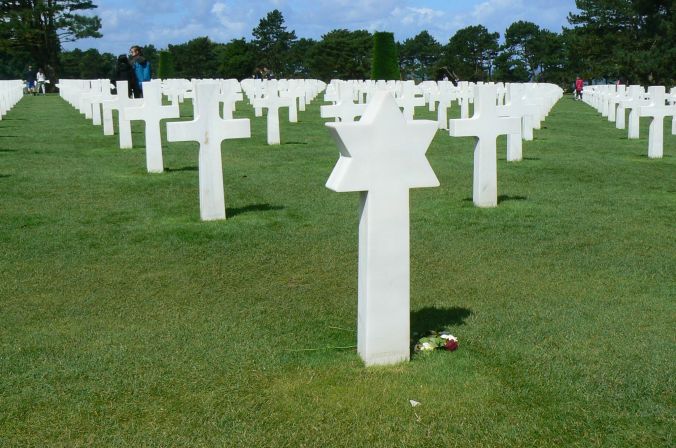
cemetery star

Is Historical Perspective Gone with the Wind?


When a friend of mine was halfway through her English Ph.D. program at Berkeley, she told me she could no longer read Shakespeare because he was “too sexist.”

Yes, that Shakespeare. The one who gave us characters like Viola, Juliet, Cleopatra, and Cordelia. But, despite the inherent strength and wisdom of such characters, Shakespeare also portrayed many of his women as powerless over their own destinies. In the 16th century. Imagine!

I was reminded of my friend when I read that a Memphis movie theater was canceling its annual tradition of showing another politically incorrect classic, Gone with the Wind. The film’s romantic image of the Old South—embodied in part by the happy-to-be-a-slave Mammy (played by Hattie McDaniel in the first role ever to win an Oscar for an African-American actor)—has apparently met its match in our current climate.

I get it. If, god forbid, Gone with the Wind is your only source of information about the Civil War, then you are woefully and dangerously underinformed. And given the sad state of American education, it’s quite possible that a 1939 movie is indeed the dominant image a lot of people have about one of the most pivotal and horrifying periods in American history. For such people, America’s original sin is likely to seem more like an episode of Leave It to Beaver.

We are living in dangerous, ugly times, where racists feel empowered to show us their faces, now that their president has told them they can safely leave the pointy white masks in the back of the closet. And if you can’t trust that your audience has appropriate context, it’s probably best not to show the film at all. After all, this theater is in the heart of the South. There are probably Confederate flags embossed on cars in the parking lot.

That said, there’s another message here, a message I’m much less comfortable with. Censorship always gives me the creeps, especially when censors let the alleged politics of art eclipse the art itself.

It’s one thing to remove statues of Confederate leaders: Robert E. Lee and Jefferson Davis were guilty of treason; they have no business standing on a pedestal anywhere. The Germans have no problem remembering their history despite the fact that no likeness of Adolf Hitler is to be found in any public space.

Gone with the Wind, however, is a work of art—a film classic that, adjusted for inflation, remains the highest-grossing movie of all time. For its era, it is a marvel of filmmaking—in terms of design, cinematography, direction, and, perhaps most of all, the iconic performance of Vivien Leigh as Scarlett O’Hara.

Let’s also bear in mind that there’s more than a little satire in the character of Scarlett, whose “fiddle-dee-dee” approach to life is judged quite harshly by the filmmakers, as it was by her creator, Margaret Mitchell. The main arc of the plot is Scarlett’s evolution from shallow narcissist to empathetic human, as her ignorance is shattered along with the immoral institutions that created and buttressed it.

In his announcement about the cancellation, the Orpheum Theater Group’s president stated, “As an organization whose stated mission is to ‘entertain, educate and enlighten the communities it serves,’ the Orpheum cannot show a film that is insensitive to a large segment of its local population.”

Hmm. In what way are education and enlightenment served by censorship? This is the same thinking that leads college campuses to issue trigger warnings and deny discussion of any ideas that don’t adhere to politically correct notions. If anything, censorship adds insult to injury, a patriarchal approach that suggests that the censor knows better than the people he is aiming to protect. The plantation parallels are a bit ironic.

There’s no question that Gone with the Wind got it wrong, very wrong. The ugliness of slavery wasn’t at the top of Margaret Mitchell’s list of plot points. Slavery was little more than a backdrop for Scarlett’s tale. There’s no question that the film is insensitive to the suffering that lay at the core of the alleged glories of the Old South. The title, of course, refers nostalgically to the antebellum South, and the story bathes it in a naïve romanticism that may have been common in its day but grates in our own. Gone with the Wind was made 70 years after the war it depicts. Now, 80 years after that, we’re still suffering the ramifications of that wretched legacy, through a long history that makes Scarlett’s ignorance look pathetic by comparison. In the age of Ferguson, in an era when the KKK marches hoodless through the streets, Scarlett O’Hara should be seen exactly for what she is: an artifact of a bygone era.

Perhaps the appropriate way to handle her story is to put it on a double bill with Twelve Years a Slave, to give the lie to the old Hollywood notion of the joys of forced labor. The latter, another Oscar winner, tells the story of slavery from the perspective of its victims, and it does so without sugarcoating anything. It’s a far more historically accurate and culturally sensitive film. But they are both excellent works of art. Sadly, Twelve Years a Slave could not have been made in 1939. That, too, is a historical reality.

Art is a product of its time. Even the classics can’t escape the era in which they were made. We could disparage Hitchock’s Rope as homophobic, My Fair Lady as sexist. Or we could accept them all for what they are and use our own critical judgment to put them in perspective. Shutting down the conversation before it’s even begun serves no one.