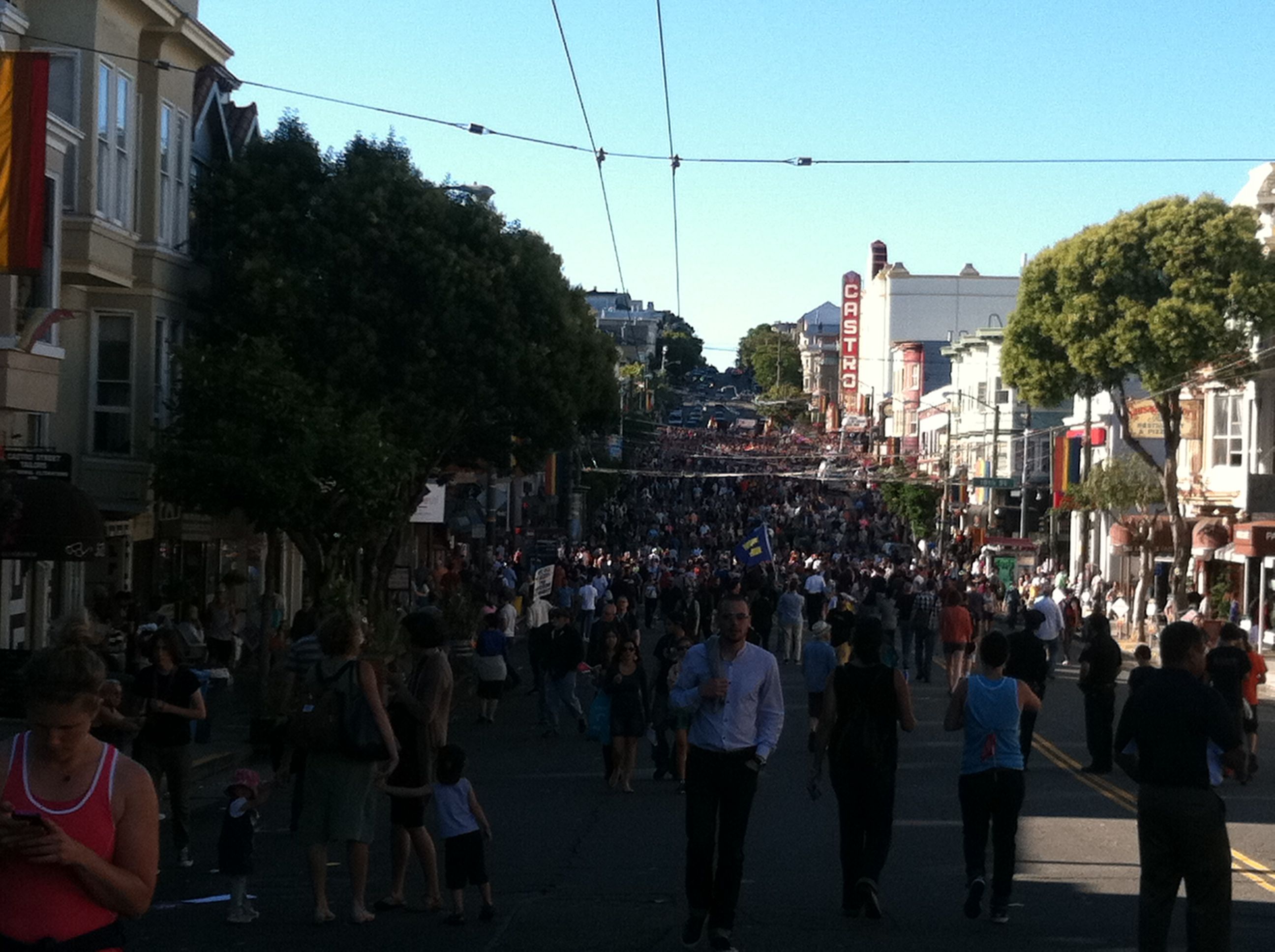
It’s Pride today in San Francisco, and for the first time in years I wish I were a part of it.
Friends are posting photos on Facebook—rainbows, drag queens, men in short-shorts—and I have a sudden longing to be there, in the middle of the throng in the city I called home just 15 months ago. But I also know that, if I were still living in San Francisco, I would probably stay away from the parade. And my curmudgeonly hackles would go up when the post-parade revelers spilled into the Castro, making too much noise and leaving too much mess behind.
As I learned last year, Pride in Minneapolis is a much quieter affair—a shorter parade, a festival in Loring Park that is reasonably easy to walk through—but I wasn’t moved to go there either this time around. Instead I stayed home in my quiet neighborhood, in my even quieter back garden, where the only in-your-face creatures are my cats. That’s one of the reasons I moved here, after all: to have a simpler, quieter life, without all the drama on offer in a metropolis like San Francisco.
Truth be told, of course, I miss the drama. Perhaps not as much as the gorgeous view from Corona Heights or the overflowing cocktails at the Twin Peaks Tavern, but enough to provoke a nostalgic pang.
When I look deeper at this feeling, though, it’s not so much that I want to be in San Francisco today. I think what I want is to be in San Francisco in 1999—or, for that matter, Boston in 1989. Not that those places were different then, but that I was. When I think about Pride, I think about my first one—sitting with friends on Boston Common after the parade. A stranger joined us, a man wearing a clerical collar and a string of pearls who referred to himself as a “Lesbyterian minister.”
I think of the tourist family who walked past our blanket on the grass and asked, in thick Asian accents, what was going on.
“It’s Gay Pride,” we told them.
The parents looked stunned. “Are you gay?” the man asked.
And one of my friends raised an arm and gestured at the thousands of people sitting and walking through the park. “They’re ALL gay!”
I’ll admit that I was as surprised that day as that innocent couple. For the first time in my life, I saw just how big my community was. That moment gave the lie to every time someone on television or in my personal life had ever shaken their head with feigned concern and told me I was doomed to spend my life alone. I was alone no longer. I was with my family, and my family was legion.
I went to the parade religiously every year after that, whether in Boston or New York or San Francisco—until 10 or so years ago, when it came to seem more trouble than it was worth. The crowd along Market Street was so thick, it was hard to find a good vantage point—unless you arrived early enough to grab a spot on the curb (which meant rising far earlier than my aging body wanted to on a Sunday morning). So my attendance became spotty, and most years, we would simply get together with friends for brunch or to walk around the Castro in our brightest colors, wearing T-shirts whose logos became less and less scandalous over time.
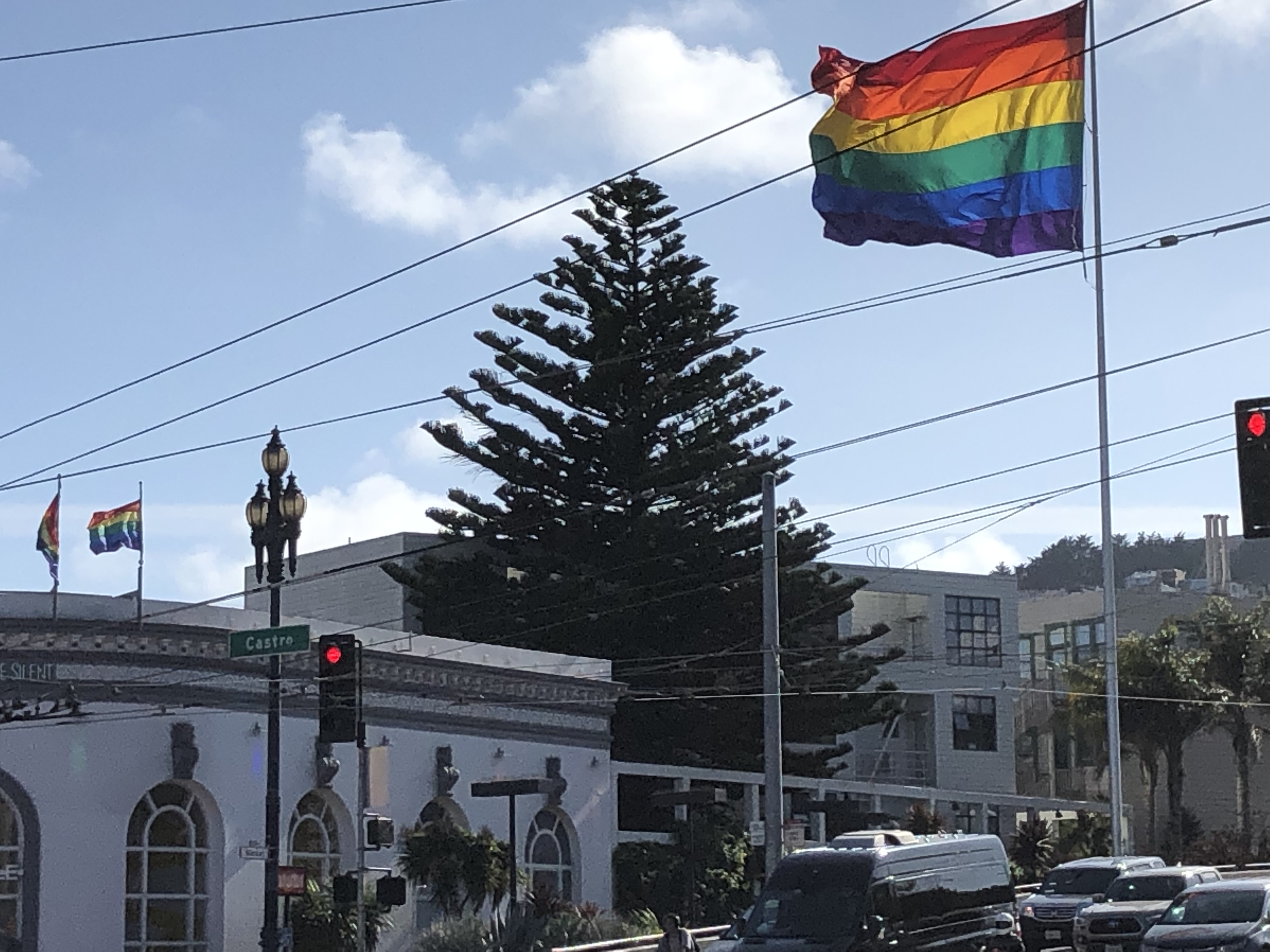
I never stopped loving Pride, but as I grew older, I came to feel more comfortable expressing that love from a distance. I had my community now—my friends, my husband, my home in the Castro. For 30+ years, I have lived a completely uncloseted life—25 of those years in the gayest place on earth, a predominantly gay neighborhood in a city where gayness is an asset and homophobia is a source of shame.
The celebration of Pride is essential, as important now as it ever was, because the struggle continues. On the surface, it looks like we’ve won. We can get married, we can serve in the military, in many places we are protected from discrimination. And one of the top contenders for president of the United States is one of us. But we are also under siege. And now that I no longer live in the gayest place on earth, I can see that more clearly. Minneapolis is a very liberal town, but it’s not quite the bubble I knew for a quarter-century. In Minnesota, I actually think before grabbing my husband’s hand on the street—an act that was second nature to me in the Bay Area.
So we need Pride because the world has not changed enough, because the race is still being run.
What makes my heart surge at the images of Pride parades, however—no matter where they are in the world—is the knowledge that every single one of them is someone’s first Pride. There are young people in Minneapolis, Milwaukee, St. Louis, and all around the world who need the same experience that I had all those years ago on Boston Common. They need to see their tribe come together and realize just how large it is. And they need to feel the joy of being with their people, the joy of being who they area and loving whom they love.
I don’t miss Pride per se, but I do miss the novelty of it. Coming out wasn’t easy, and the first few years after it had their challenges, as I learned to find my place in a new world. But when I think back to that period, it’s not the struggle that I remember so much: it’s the sense of liberation. Freedom, of course, isn’t free. But it is, undoubtedly, priceless.
Happy Pride to all, whether it’s your first or your fiftieth!
 Lewis DeSimone