I’m currently working on a novel that has its roots in my own life. Other books have borrowed the enamel and the cavities; this one requires a full-on root canal. It’s a book I’ve been living with for years now. At first I tried prettying up the story—making the characters nicer, richer, more articulate than the real people who inspired them. But the heart was missing, so I began stripping away the artifice. After many attempts, I finally think I’m onto something. The story is now more grounded in the reality of the world I lived in at the time, and how I felt about it. But I’m still manipulating the events, the timeframe, the nuances of the characters. It’s still a novel. I believe that fiction more easily gets to the truth—emotional, spiritual truth—than memoir (which is always imperfect, anyway, and therefore not as honest as it claims).
In the midst of my angst over the book, my attempt to harness real events into a constructed universe, I stumbled upon a cautionary tale about the pitfalls of straddling the line between fiction and history.
The recent film Roofman is distinguished by its cast: a charming and emotionally complex Channing Tatum, a hilarious Juno Temple, a deliciously wicked Peter Dinklage, and an absolutely brilliant, Meryl Streep-channeling Kirsten Dunst. These performances are all the more remarkable because the actors rise so far above the material they’ve been given.
The filmmakers constructed an entertaining and suspenseful comedy that keeps the viewer riveted for more than an hour. But then reality intervenes. Literally.
Because Roofman is based on a “true story,” the filmmakers set themselves an impossible task. The movie it seems they wanted to make is the story of a loser with a heart of gold who gets tempted toward criminality because of a desperate desire to win back his family. So far, so good.
But as Jeff’s world begins to crumble, darkness creeps in. His desperation leads to increasingly violent moves. Whereas he began his life of crime by robbing McDonald’s outlets and playing a soft-spoken Hamburglar—making sure his victims all had coats before locking them in the freezer—by the end of the movie he’s pistol-whipping a guy and setting a business on fire. Over the closing credits, we learn that the real Jeffrey Manchester may not have been quite the charmer Tatum makes us fall in love with. His crimes were more extensive, and the film takes significant liberties with the order and circumstances of his spree.
And there’s the rub. The ending seems to be something out of the old Hays Code, where the character, no matter how charming or sympathetic, must be punished for straying from the straight and narrow.
The real problem, though, is that the filmmakers can’t decide how much reality to use. So they opt for a schizophrenic movie that destroys the verisimilitude of its central character. Tatum as Jeff is a charming criminal from the get-go; but in the latter half, that charming guy starts putting people’s lives and livelihoods in danger, and there’s no sufficient motivation to explain the change in his moral compass. Sadly, Tatum has invested so much in making us like the guy that he can’t believably go to a dark side, so the audience is torn between rooting for a hapless man and wanting him to get his comeuppance. (I for one just wanted him to be smarter. There’s a key moment near the end when he seems to miss that he’s being set up.) What’s really happening is akin to Jeff Daniels’s dilemma in The Purple Rose of Cairo: a fictional character steps out of the screen and becomes a real human being, a role he seems constitutionally unfit to play.
Roofman might simply have used the disclaimer “inspired by a true story” and gone off on a different tangent—changing names and locations along with the plotline. Instead, the filmmakers seem to have fallen into the trap of trying to please a public that increasingly finds “reality” somehow more compelling than well-made fiction.
Whether docudramas or memoirs, I always find myself wondering why so many people seem to think that a story that “really” happened is inherently worthier of attention than one that’s completely made up. Not that fiction is ever completely made up; it always contains elements of the real experience of the creator and the world around him or her (the enamel if not the root).
Roofman’s problem is of a different sort. Stories—and especially characters—should be internally consistent, no matter the source material. My research suggests that the plot that triggers the climax of the film (Jeff’s need for money to finance his plot to leave the country) was invented by the filmmakers, perhaps as a way to explain the violence of his final robbery. (The film also places his act of arson in this period, though it was actually committed long beforehand.) They must have thought they were solving the problem of the plot. But in the process, they deconstructed the protagonist—who was the very hook for the story to begin with.
If you want to enjoy this movie, I recommend forgetting that it has any connection to reality. And focus your attention instead on Kirsten Dunst’s transcendent performance.
One of the many regrets of my college years is not enrolling in “The Age of Johnson,” the renowned Walter Jackson Bate’s class on the English Enlightenment. At the time, I found the eighteenth century boring, and believed the tidbits of it I’d studied in English 10, a year-long survey of literature from Beowulf to Virginia Woolf (so went the joke) would suffice.
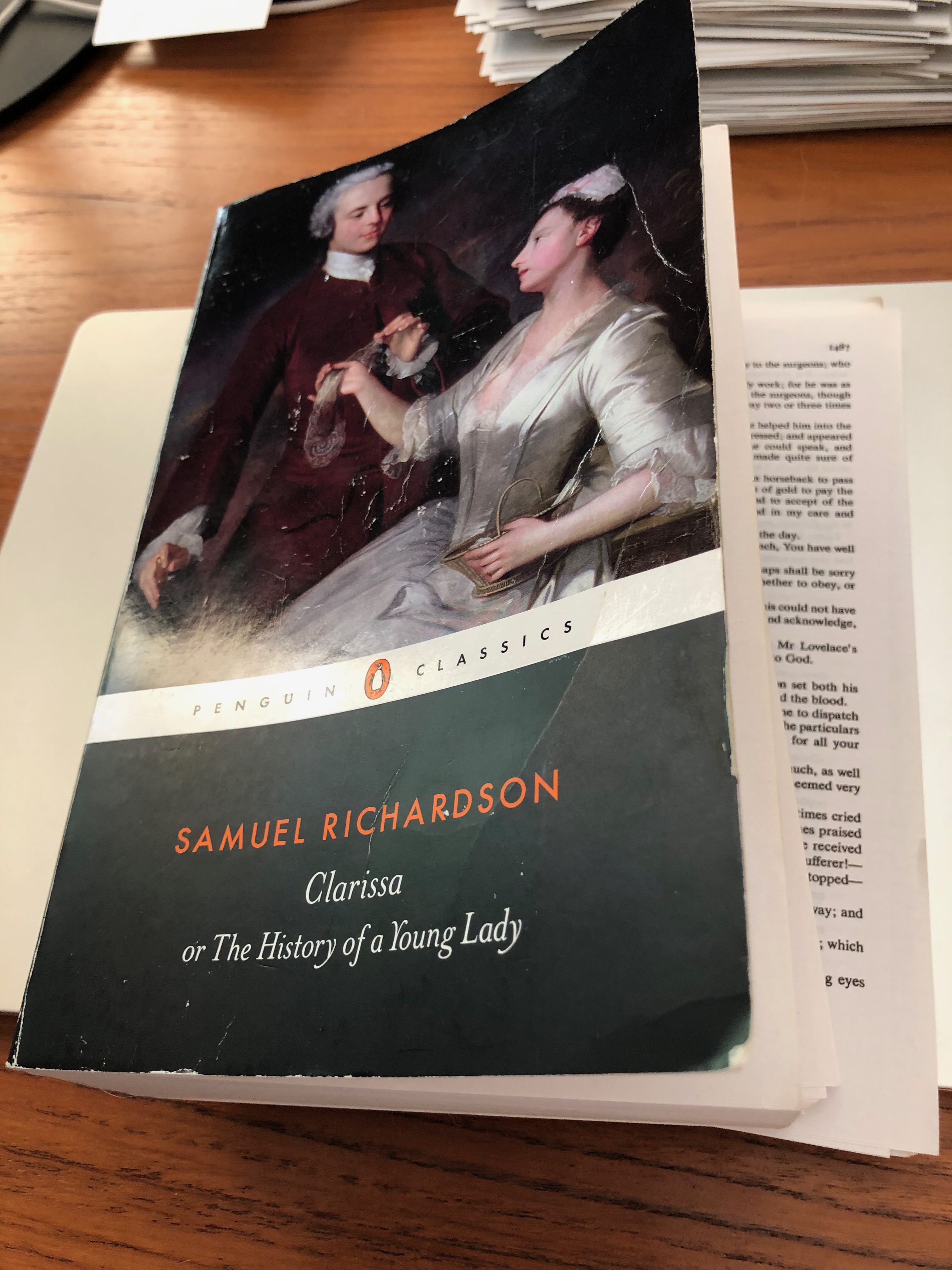
But the gap in knowledge always bugged me. So, decades later, I decided to give myself a course in the eighteenth century. This year, my reading list included a history of the period, Ritchie Robertson’s The Enlightenment: The Pursuit of Happiness, 1680-1790, as well as a number of key works of literature, including Goethe’s The Sufferings of Young Werther, Boswell’s Life of Samuel Johnson, and a collection of Johnson’s own writings. I saved the most intimidating work of the century for last: Samuel Richardson’s doorstop masterpiece, Clarissa; or, The History of a Young Lady.
I’ve heard Clarissa described as the story of a perfect person surrounded by villains. This conceit, I believe, shortchanges Richardson, reducing his masterpiece to a morality play. While one of his goals in the book was to praise virtue (explicitly Christian virtue), the work itself—like that of other writers in the age of Enlightenment—examines its themes through the depiction of human character as complex, forged and developed through circumstance and exhibited through behavior. The epistolary form Richardson chose for Clarissa is an effective vehicle specifically because it enables him to dwell so deeply on character: as Clarissa and others write their letters, they reveal depths of their personalities that would be less obvious to the reader in a more conventional format.
I prefer to think of Clarissa Harlowe as a tragic hero, and tragic heroes always have tragic flaws. Hers is youthful idealism. Eighteen years old at the start of the novel, and quite sheltered, she has never been tested by the world. For all her talk of being an obedient child, I find no evidence in the book that she has ever obeyed her parents by doing something she was not already inclined to do. In fact, I find no evidence of them having told her to do anything until Solmes comes along and they command her to marry him. What the evidence in the book does support is a sense that Clarissa is spoiled—given everything she wants and praised at every turn. Like many of today’s children, she receives trophies for attendance.
I loved the book, despite its length, though the editor in me longed for a hatchet. At 1,500 very dense pages (an estimated 900,000 words), it’s the longest novel I’ve ever read in a single volume—which, by the way, began to fall apart in the last couple of hundred pages. (In the 18th century, the book was originally published in two volumes.) While the length enables Richardson to delve deeply into his characters, there are long stretches that tried my patience. Basically, I think of Clarissa as a 900-page thriller bookended by two 300-page slogs.
For the last couple of hundred pages, I constantly struggled to keep the whole thing from spilling onto the floor.
Spoiler alert, in case I haven’t already scared you away from taking this monster on. And if you’re still with me but think this blog is getting too long, please remember that I’m sparing you about 1,495 pages of reading.
Formally, Clarissa is a bildungsroman, examining the heroine’s maturation in three distinct stages.
1) The first section depicts Clarissa’s relentless negotiation with her unyielding family to release her from marrying Solmes, a man she finds repulsive. There’s intransigence on both sides. Clarissa prides herself on being a dutiful daughter, but in this one case (albeit the most significant request she’s ever received), she draws the line. Having been refused nothing before in her life, she’s at a loss.
Of course, forced marriages were the bread and butter of the English novel for two centuries (not to mention all of polite society), but Clarissa takes the theme to another level. For 300 pages, she looks for a way out, but, because she is indeed powerless, she can offer only a passive-aggressive response: request more time (hoping her parents will relent), and then reiterate the same arguments again and again (hoping to exhaust them by a thousand cuts). This is not to say that she doesn’t have a point. Solmes is clearly a fool, but many a novel has been written about the tragedy of women forced to marry fools.
Her parents, of course, never believe her argument that she doesn’t want to marry at all. They’re convinced that she’s rejecting Solmes merely because she’s in love with the libertine Robert Lovelace. Although she is attracted to him, marriage is clearly not her objective (nor is sex). Lovelace, however, is the only person in her world willing to help her escape from Solmes. Even if he’s doing it solely for his own nefarious reasons, no one else steps up to the plate. Thus, when she’s in a particularly vulnerable moment, he tricks her into running away with him.
Convinced that Clarissa has gone off with Lovelace deliberately, her family disown her. They tell themselves that she deserves whatever she gets, and refuse to offer any help or even to communicate with her until it’s too late.
2) Now the thriller begins. Lovelace’s motives, for all his avowals of love for Clarissa, are primarily sexual. He imprisons her in a high-class bordello, restricting her movements under the guise of protecting her from being kidnapped back by her family. Lots of drama ensues, particularly as Clarissa contrives her escape from him, followed by his trickery to get her back, after which he drugs and rapes her.
It’s during this long stretch of the novel that Clarissa grows as a character, developing and revealing an inner strength that seemed inaccessible in the first section. She fights back at Lovelace, verbally and physically, as she begins to understand and own who she really is beneath the fine clothes and beyond the placid confines of her parents’ home.
The drama of this portion of the novel also benefits from a structural choice. While the first section is told mostly in Clarissa’s voice, through letters to her best friend, Anna Howe, Richardson switches gears once she’s free of her parents and gives the bulk of the narration to Lovelace, through letters to his friend Belford. And Lovelace, as a worldly man and a lusty one, has a much more dramatic and engaging style. Even as the reader is horrified by his duplicity and cruelty, you can’t help being riveted by his storytelling power. He’s charming, funny, and more than a bit deluded, characteristics that combine for a great read.
3) Once Clarissa escapes again, after the rape, she shows signs of building an independent life. But another incident (not of Lovelace’s making) breaks her spirit at last, and she then spends 150 pages “dying of grief” (that’s apparently how heroines succumbed before consumption). From a modern sensibility, of course, this is hogwash. What Clarissa has is depression, and she’s effectively killing herself by not eating properly.
It’s in this period that Clarissa reaches her apotheosis. In a typical bildungsroman, the hero would now embark upon a new phase of life, invigorated by the sense of self and strength developed through calamity. Think Jane Eyre after the fire, or Brunnhilde before hers.
Where Clarissa used to be called a “perfect creature” by one and all, the terminology now shifts more and more to “angel.” Broken by the real world, she turns to the supernatural. She lives for God and longs for the afterlife, endless trips to church her only reason for leaving the house.
At this point, of course, I got seriously frustrated with her and what feels like regressive behavior. She’s back to the old Clarissa, the one before she grew a spine, the one who is simply too good for this world. If she had only taken as much responsibility for her life as she now does for her death (going so far as to purchase her own coffin and place it melodramatically beside her bed), the story would end in a very different way.
But maybe she really doesn’t belong in the material world. That seems to be what Richardson wants us to believe—that Clarissa is a spirit who happened to take human form for nineteen years. After all, he does fill this last section with an awful lot of Christ imagery.
Thus, the bildungsroman culminates not in adulthood, but in death. After the 150 pages of dying follow the 150 pages of survivors grieving for her and realizing their own roles in her tragedy, concluding in a duel between her cousin and Lovelace, in which the villain (I’d say antihero) finally succumbs. Lovelace’s regret and sense of guilt are powerful in this section, and one of his letters in particular is my favorite part of the entire novel.
The psychology of the book overall is impressively complex, suggesting the insights more commonly found in a twentieth-century novel. Lovelace, I think, is Richardson’s most brilliant creation. He is torn in painfully real ways: Part of him knows what an ass he is and recognizes that his treatment of Clarissa was unforgivable. But there’s also a part that truly loves her. He wants to blame her family, or even Clarissa herself, and to think that his pain is worse than any of theirs. (I told you he was deluded.) When he goes off to the continent near the end of the book and begins to feel himself again—joyful, strong, perhaps even rakish—he’s really hiding the truth, the guilt that’s destroying him. And there are distinct hints in the duel scene that he takes a suicidal dive.
It’s always risky to read classic literature through a modern lens, but I think it behooves us to hold both sensibilities at once. Great literature is immortal not just because it depicts its historical period well, but because it enables us to see that the human condition is constant.
For me, the great tragedy of Clarissa is a common one: the disconnect between individual sensibilities and social dictates. The economics of the time led women to be treated as property to change hands, from father to husband, in the furtherance of wealth. This notion was supported by religious injunctions against sexual pleasure. A bride had to be a virgin, or she was “ruined.” And a man, less able and less encouraged to repress his sex drive, lived in sexual frustration until marriage (and probably after), save for the help of “loose women.” (The bordello in the novel, where women are rented out, feels almost tame compared to the outside world, in which they’re sold.)
Clarissa epitomizes the denial of human nature at the heart of the religion of its time (and most of the religion of our own). The heroine seems less traumatized by the violence done to her body than by the dishonor done to her “soul.” Unable to accept that her body, as the temple of that soul, has been defiled, she chooses to jump over the rest of her life and head straight for heaven instead. The depression that leads her to this fate is a mental illness, and her faith a mechanism for passive suicide. She contemplates active suicide, but rejects it as a sin. What, I am left to ask, is the difference?
Yes, Clarissa is a victim of other people and of her society. But equally implicated in her tragedy is her inability to let go of her idealism. When she’s on the verge of finally being done with Lovelace, she learns that she isn’t as independently minded as she always thought. She convinces herself that she has sinned by allowing Lovelace to take her away from her family and that she must pay the price for that lapse in filial duty. If she were a little older and a bit more worldly, she might see another way out. But, like most people her age, in any time, she thinks she already has all the answers, and that is her downfall.
Throughout the book, I found myself wondering how reliable these narrators were. Through their letters to their respective friends, we learn that Lovelace and Clarissa routinely lie to each other. In addition, they occasionally hide certain truths from their correspondents, but I think they reserve the biggest lies for themselves. Midway through the book, Anna tells Clarissa, “I do know you love him,” and the statement comes as a revelation to the reader. After all, Anna knows her better than we do. The most Clarissa subsequently admits, when pressed, is that she “could have” loved Lovelace if he hadn’t been so brutal to her. The depth of her initial feelings thus remains a mystery, but Anna’s remark made me read more carefully, looking for hints of something more.
One of the novel’s most disturbing issues is the notion (repeated by several characters) that the solution to Clarissa’s dishonor would be to marry her rapist. In other words, she’s spoiled goods, and the only way to undo that is to have Lovelace make an honest woman of her, since no one else would want to. Clarissa herself contemplates this option, and much of the drama in the middle portion of the book concerns Lovelace’s deceiving her into believing their marriage would reconcile her to her family. Throughout the second half of the novel, in fact, Clarissa and many of the other characters go back and forth on the question, at times advocating it, at others dismissing it.
Indecision, after all, is at the core of the novel’s drama. If Clarissa could make up her mind, her story could be told in a few hundred pages. Part of Richardson’s genius is his willingness to harbor complexity and ambiguity. Lovelace performs villainous acts, but he also has noble qualities, and an emotional core that he fears and can’t fully access until forced to face the consequences of his behavior. In a mirror image, Clarissa is a gentle and pure soul, but she also has access to strengths she is unsure how to use. Human character, Richardson shows us, is complex and untidy. Sometimes we can’t even understand ourselves, let alone anyone else.
I wonder how I would have reacted to this book if I had read it in college, when I was closer to Clarissa’s own age. From the perspective of midlife, it’s easy to find fault with Clarissa’s stubbornness and devotion to an idealism that ultimately destroys her. But if I cast myself back in time, I see an early adulthood riddled with errors and near-misses. At Clarissa’s age, we all think we know better, we all think the world is as simple as our circumscribed experience suggests. For me, Clarissa is both an object lesson and a reminder that youthful idealism, for all its dangers and annoyances, is key to the forging of character. There’s a tragedy in succumbing to it, but the greater tragedy may be in losing it to the dull practicality of maturity.
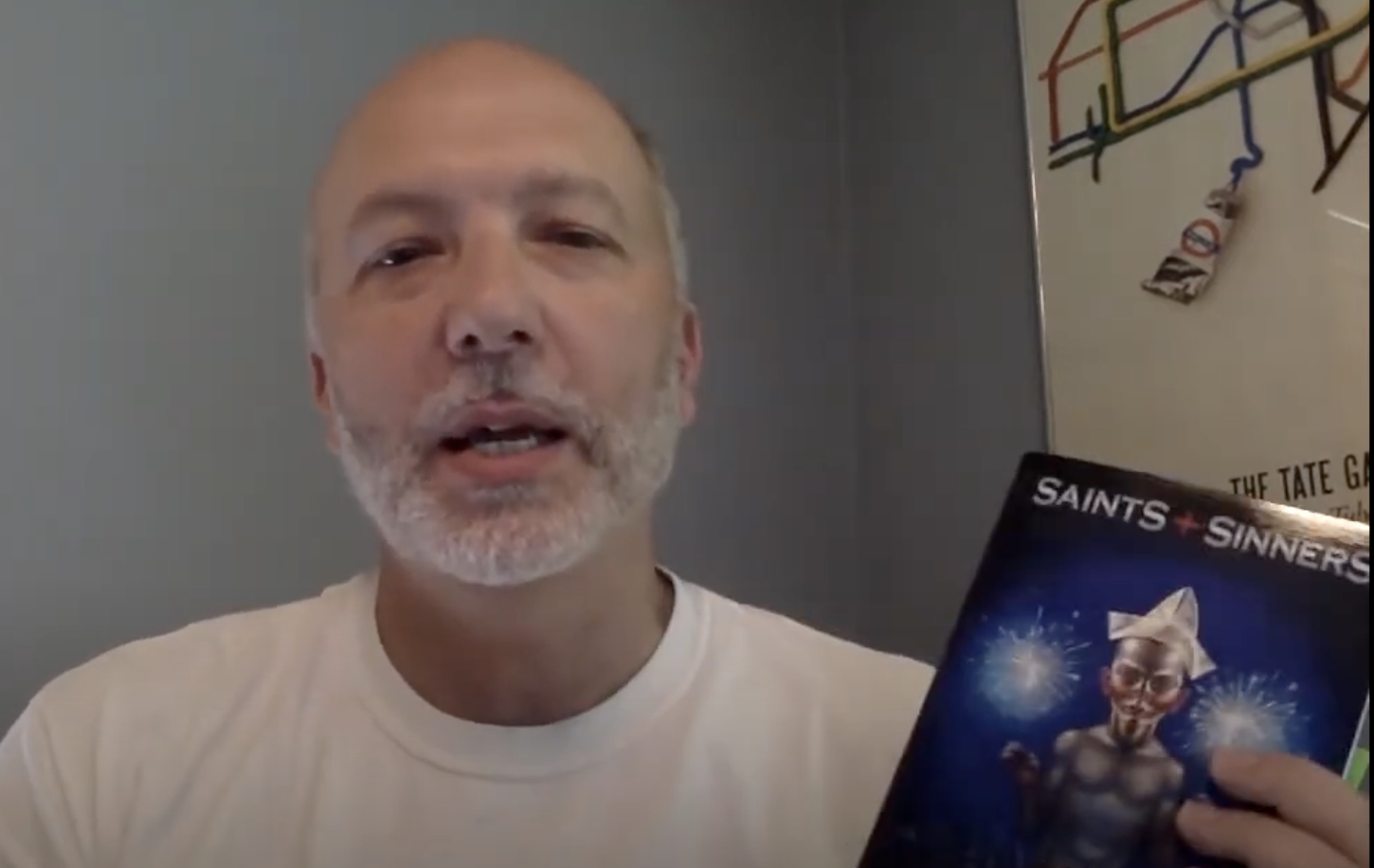
A bit of a blast from the past. The annual Saints & Sinners Literary Festival holds a contest for short fiction. At the 2021 festival, I was named a runner-up for my story “Mesopotamia.” Unfortunately, the festival didn’t happen that year because of the pandemic. So in place of the usual in-person reading, a number of writers contributed to a group video, which is available on youtube.
My story for the contest later became the opening chapter of Exit Wounds. I thought it would be fun to share the reading with you now that the book is out. So if you haven’t heard me read in person, here’s the next best thing.
My reading begins around the 5:00 minute mark on the linked video. And I’m sure you’ll be interested in hearing others, as well. Enjoy!
Since my own jury experience, more than 10 years ago now, I’ve found myself drawn to the high-profile trials that increasingly litter my newsfeed. In 2021 I was riveted to the Derek Chauvin trial, watching from gavel to gavel when I was supposed to be “working from home” (to be honest, it was a slow period at the office). I dabbled in the Alex Murdaugh trial, as well as Gwyneth Paltrow’s lawsuit (that one could have been mistaken for a sitcom), and even—ever so briefly—the train wreck of Johnny Depp v. Amber Heard.
Most recently, my obsession drifted toward Karen Read, whom I’d first heard about in an Atlantic article about Turtleboy, her most ardent and somewhat ridiculous fan. I watched the one-sided Max documentary, and wondered if it was a PR stunt for the retrial or a pilot for Read’s second career as yet another narcissistic reality-TV star. Once the new trial was under way, I grabbed pieces of it off youtube, having little patience for the daily grind. What I saw threw me back to my initial jury experience, which had set the stage for the fictional trial in my novel Exit Wounds.
My first thought, in the aftermath of Read’s acquittal, was that yet again, a jury had had a hard time trusting circumstantial evidence. If no witness saw the crime with their own eyes—or documented it on social media—many juries seem to struggle against even a mountain of evidence.
My second thought was, This all sounds too familiar. Watching scenes from the trial, I was reminded of other criminal cases that got caught up in conspiracy theories:
Russia, Russia, Russia: Read’s defense attorney, Alan Jackson, began his closing argument with a simple phrase (repeated): “No collision. No collision. No collision.” Change one vowel and we’re back in the Mueller investigation. I don’t know about you, but if I were on trial in bright blue Massachusetts, the last thing I’d want to do is associate myself with Donald Trump.
If the glove don’t fit: Despite a mound of evidence and the defendant’s own words, her defense relied on seeding doubt by casting blame elsewhere. Apparently they thought it was easier to believe that evidence was planted by Canton’s version of Mark Fuhrman. And they tied it all up with a bow by having a victorious Read state on the courthouse steps, “No one has fought harder for justice for John O’Keefe than I have.” If O.J. were still alive, he might join with her to find “the real killers.”
Maybe I’m old-fashioned, but my gut rebels against conspiracy theories; as a rule, they don’t pass the logic test.
Sherlock the Cat inspecting pawprints in the snow
First of all, the idea of all that digital evidence—notably, the black box in Read’s car and the health app on O’Keefe’s phone—lining up by chance is a bit of a stretch. My favorite piece of evidence, though, is one statement Read made in a Datelineinterview: “He didn’t look mortally wounded as far as I could see.” (Excuse me, what?)
Second, I wonder how many people would have to be involved in order for Jackson’s theory to be true. The more conspirators there are, the more fragile the bond. I wasn’t on the Read jury. I didn’t see or hear all the evidence, so I’m not arguing that Read was guilty. In fact, as I listened to Jackson’s closing, I found myself struck by many points (pardon the pun). It wasn’t that I believed the conspiracy per se, but he did plant enough doubt in my mind that I imagine, as a juror, I would have had to think long and hard about conviction. From my distant perspective, I think the most likely answer is that Read backed her car up in a huff, accidentally hit him, and had no idea that she had. That’s not exactly “not guilty” of manslaughter, but it skates the line.
All that said, I’m not ready to reject the verdict. But it still makes me a bit queasy.
I have to wonder what this verdict, like the 1995 O.J. abomination, suggests in a broader sense about celebrity, confirmation bias, and the human struggle between reason and emotion. It seems obvious now that the O.J. jury wanted to believe he’d been framed. The race card worked. In Read’s case, the defense took the strategy even further: not only did the police plant evidence; they actually committed the murder.
Studies have shown that, despite conventional thinking, circumstantial evidence is more reliable than direct (i.e., eyewitness) evidence. People don’t see everything clearly. People don’t remember very well. Data, on the other hand, doesn’t change its mind. It can be interpreted differently, but the data, for lack of a better word, is the data.
One of my co-jurors in that long-ago case was obsessed with the concept of reasonable doubt. The only problem was that he had no idea what it meant. He would bark the phrase out like a mantra to support his obstinance, but his arguments proved time and again that he was confusing it with “shadow of a doubt.” The rest of us were unable to disabuse him of this notion. And, like Auntie Mame the morning after a raucous party, the jury was hung.
We live in a time of conspiracy theories and willful ignorance. Democratic pedophiles in a pizza parlor. Microchips in vaccines programmed to cause autism. A stolen election. A love-in at the Capitol that just happened to include a noose for the vice president. A crowd of 700 protesters in the nation’s second largest city who need the Marines to keep them in check.
I spoke with a family member recently who tried to convince me that Nancy Pelosi orchestrated January 6 to make Trump “look bad.” When I pressed him, he fell back on the idea that “we don’t know everything,” essentially arguing that objective reality is a myth. Maybe Pelosi spearheaded the whole thing. Maybe Marjorie Taylor Greene is a genius. Maybe there’s a leprechaun on the dark side of the moon. Nobody knows for sure.
And the mountain of evidence to the contrary? Maybe that’s just a buffalo on the prairie.
We used to have martinis on Monday evenings as consolation for beginning a new week, and again on Fridays, to celebrate having survived it.
Wednesday was Hump Day, the beginning of the much-craved slide toward the weekend. And the weekend, of course, was what it was all about.
I’ve been retired for more than a year now, and one of the strangest things to get used to is the absence of those markers. I no longer dread Mondays because they’re no different from Tuesdays. In fact, the sole day of the week that stands out now is Sunday—and that’s only because the New York Times shows up on my doorstep. (Side note: Martinis are still a twice-weekly event. At least.)
For the longest time, I looked forward to retirement. That’s what I was working for, I told myself. Along the way I imagined all the things I’d do when the time finally came—the new hobbies I’d start, the places I’d go. Half of my bucket list was designated for post-career activities. Most of all, though, I pictured retirement as the time when I would be free to write.
How a retiree tells one day from another
The most common question I get at readings is whether I have a ritual for writing. Everyone seems interested in how a writer squeezes in the time. The truth, for me, was that while I wanted to write every day—to be one of those mythical creatures who get up in early-morning darkness and dash off a few pages before heading to the office—when it came right down to it, there were too many other things going on. So I basically wrote my first few novels on Saturdays (which explains why so much time passed between publication dates).
Now that’s all changed. In theory, at least. I do write every day, if only for an hour or two. (The concept of being a “full-time” writer has never really appealed to me. Kafka was crazy enough with a day job; imagine if he’d sat alone in a studio for eight solid hours.)
Exit Woundswas written in less than a year—a record for me. It’s not spilling out the words I find difficult. The time-consuming part is revision. That’s where most of the work is, and frankly, most of the fun. The manuscript becomes a bit of a puzzle at that point, and my job is to rearrange the pieces, or add more, or cut some, until it all makes sense.
I once wanted a career as a writer, but over the years I’ve come to embrace writing as an avocation—if only because making a living at it isn’t in the cards for the vast majority of us scribes. And even in retirement, that’s what it is. I don’t want to think of writing as a “job”—that connotes drudgery. When writing stops being fun, it stops, period. Like my newer hobbies—gardening, wine tasting, bridge—writing has to be done for joy. Otherwise, I don’t have time for it.
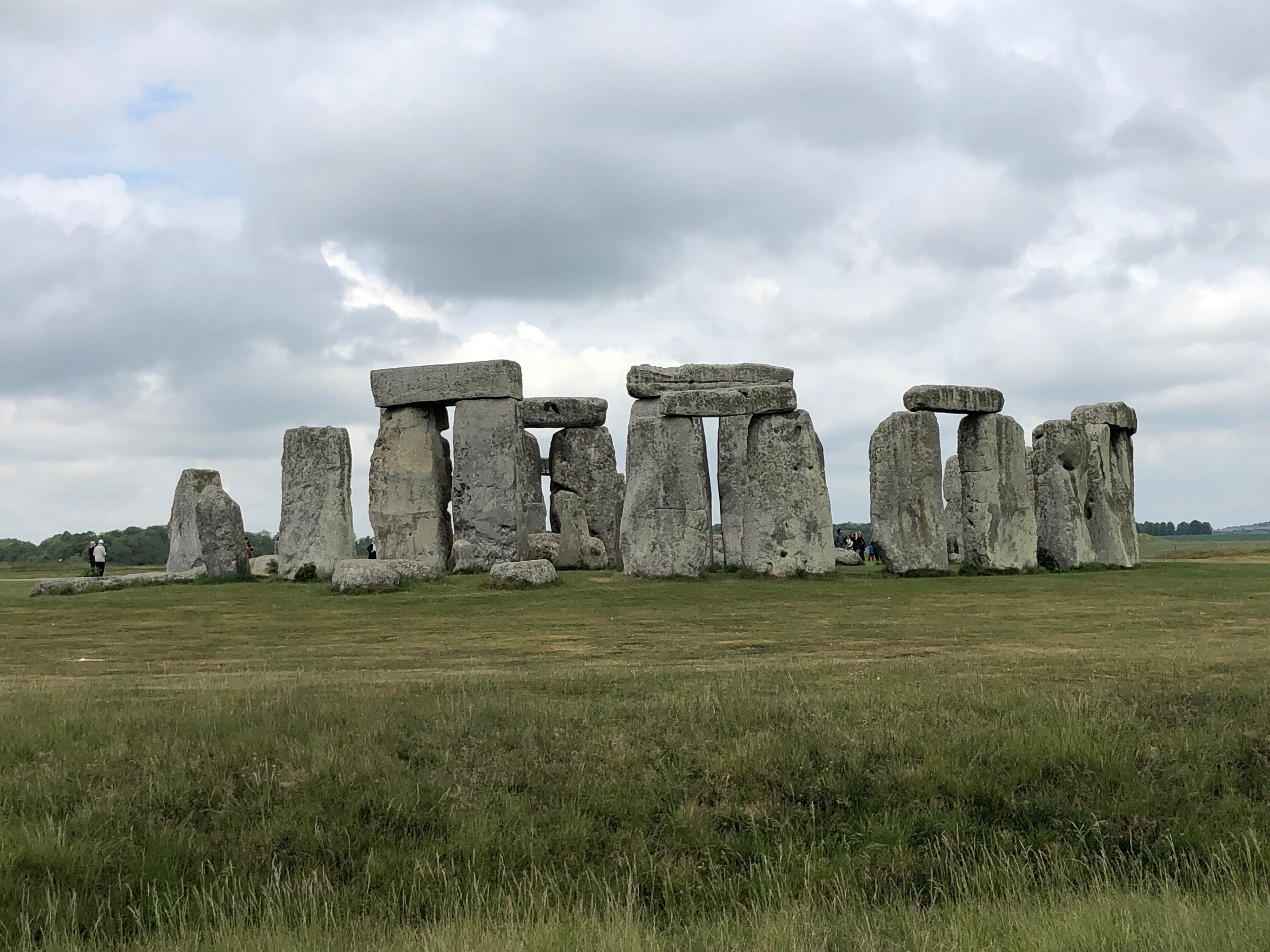
The first thing you notice about Stonehenge is its isolation. As our driver noted, warning us not to miss our scheduled departure time, the site is literally in the middle of nowhere. The visitor center, including the entrance to the site, is a 30-minute walk from the stones. When we arrived, the lot was already packed with dozens of buses, and a crush of smaller vehicles filled the car park on the other side of the road. But never fear, we were told, there were shuttles to take us directly to the stones. When we arrived, the line for the shuttle was nearly a hundred deep, but we were assured there was only a 10-minute wait. When the first one arrived several minutes later, it hardly made a dent in the line of people waiting, so we decided to forgo the bus and make our way on foot.
All would have been well if I hadn’t twisted my knee a week before and further aggravated it walking the uneven pavement in London, but I decided to “keep calm and carry on.” We proceeded along a lovely stretch of Salisbury Plain, past a number of burial mounds and a few stands of trees, before the stones came into view.
The site itself was so quiet and manageable I found myself wondering where all the people from the visitor center had gone. A rope about 20 feet from the outer ring of stones cordons off a paved path, which we followed counter-clockwise around the stones.
The quiet enhanced the otherworldly quality of the place. Though the placement of the stones has been dated to around 5,000 years ago, the means of construction and the purpose of the site are less certain. The mystery, of course, is part of the attraction. Sometimes we humans appreciate questions more than answers.
As I looked through the outer ring to the center slab, I couldn’t help thinking of Tess of the d’Urbervilles, who slept on the altar stone the night before her arrest at the end of the novel. That story has always been a favorite of mine, key to my senior thesis in college. Whatever the original use of Stonehenge, Hardy placed his heroine here to identify her as a sacrificial lamb, an innocent corrupted and ultimately destroyed by a world that valued her for her beauty alone and punished her for wanting to be more.
That moment alone makes the site sacred to me. Literature, after all, is my religion, its characters my patron saints. And the trip to Stonehenge, on my bucket list for years, was a pilgrimage. Unfortunately, it’s not Lourdes; it didn’t heal my knee. But for half an hour, circling the stones, marveling at the achievement of an ancient, unknown people, I didn’t feel the pain at all.
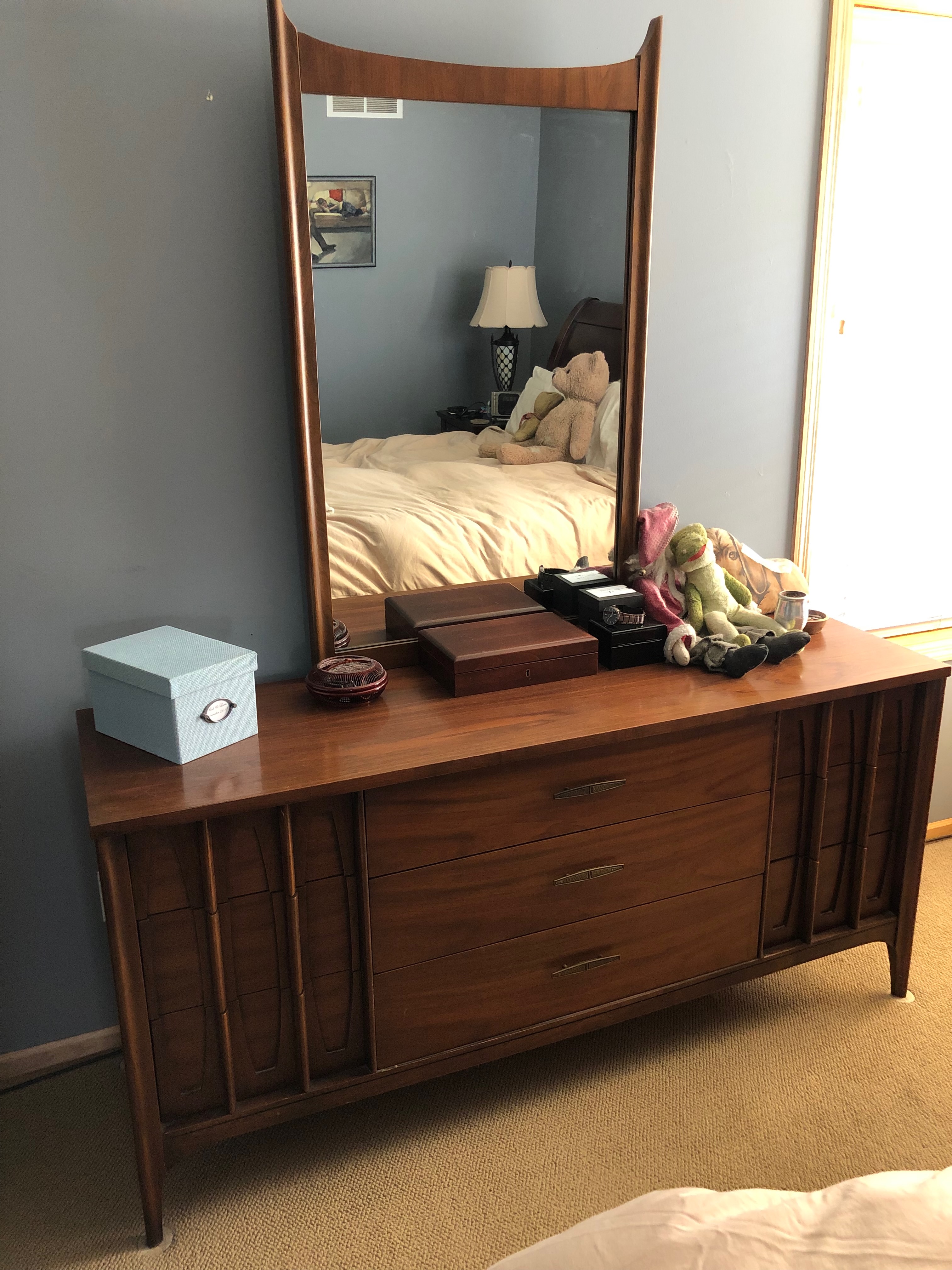
My parents were into mid-century modern furniture without ever having heard the term. I suppose that’s because they bought it at mid-century, when it was just called furniture. When I was growing up, I thought it was nice but boring. But then I came out of the closet.
The style seems to be hotter—and gayer—now than when it started. It’s so hot and gay that it even has a sitcom named after it. Mid-Century Modern premiered on Hulu last weekend, coincidentally when I was at the Saints & Sinners Literary Festival to present at a panel on middle-aged homosexuals. (The actual title of the panel was “Generational Change in Gay Culture and Literature,” but that’s a mouthful.)
The show, brought to us by the same production team that created the groundbreaking Will & Grace, which, for me, defined “must-see TV” for a decade, stars Nathan Lane, Matt Bomer, and Nathan Lee Graham in a familiar formula—a group of friends living together in a created family that’s almost as dysfunctional as the home-grown variety.
Unlike its predecessor, a very urbane New York show, Mid-Century Modern takes place in Palm Springs. While Will & Grace’s characters were in their energetic and gorgeous thirties, this show focuses on an older set (which, interestingly enough, Will Truman would fit quite well in, at this point). It’s basically a cross between Will & Grace and The Golden Girls.
The very idea that Matt Bomer can be considered middle-aged boggles my mind. He’s actually more than 20 years younger than Nathan Lane, the oldest of the trio, but the chemistry among the three is strong enough for me to suspend my disbelief. If you squint, you can just buy into the conceit that they’ve been friends for thirty years (let’s forget that Bomer would have been underage).
Aside from the gay subject matter, Mid-Century Modern feels like an old-fashioned show, entertaining rather than didactic, its plots easily resolved in 30 minutes. It’s the kind of TV I crave these days, a relief from the chaos of the real world. It’s a delicious fantasy, where the perils of aging are deliberately glossed over. Even when the boys go out cruising, on a trip to Fire Island, there’s no sense of generational conflict. Arthur (Graham’s character) gets a little daddy attention, but the difference in age between him and his would-be suitor is barely acknowledged.
The setting, of course, has a lot to do with it. My own peer group (before we hit 40 ourselves) used to deride Palm Springs as the place where old homosexuals went to die. But even then we knew the city was both literally and metaphorically an oasis—where there’s water in the desert and civility in a hateful world.
That’s what San Francisco was for me, from the time I arrived in my early thirties to my reluctant departure 25 years later—a refuge from the harsher world outside. My novel Exit Wounds explores how the city, and the gay community that has enlivened it for so long, have changed over the years, as the distinctive qualities of both have begun to blend with the dominant world they once rejected.
Living the quiet life in Minneapolis, I’m in a holding pattern now, but I’ve often thought I might end up in Palm Springs, that hotter (at least on the thermometer) bubble. And now, after watching Matt and the Nathans, I find myself rethinking my aversion to desert weather. Being in a gay haven again, with people my own age, might just make up for it. Like my mother’s furniture, we were born in the mid-century era, and are now in the middle of our own century. We’re not done yet.
When my mother died a few years ago, we spent several days going through her things. There were lovely mementos, from jewelry to dishware to family photos. But there were also an inexplicable number of meat thermometers, for someone who rarely cooked more than scrambled eggs. More Hummel figurines than we knew what to do with. And so many never-used dish towels I wondered if she’d been expecting a flood.
We made the usual piles: keep, donate, throw. Most of her tchotchkes we laid out on a communal table in the building’s mail room. Every couple of hours, we’d come back with more stuff and find that her neighbors had already cleaned out the last batch.
I didn’t even think about the furniture, assuming the expense of shipping it 1,000 miles wouldn’t be worth it. And then my husband took one look at the mid-century modern bedroom set and insisted we take it. I’m so glad he did. That stuff is sturdy, still beautiful after 60 years and ready for more.
I just returned from the annual Saints and Sinners Literary Festival in New Orleans. It was my first time there since the pandemic, so it felt a bit like a homecoming. The weekend was full of thought-provoking panels, inspiring readings, and the joy of community.
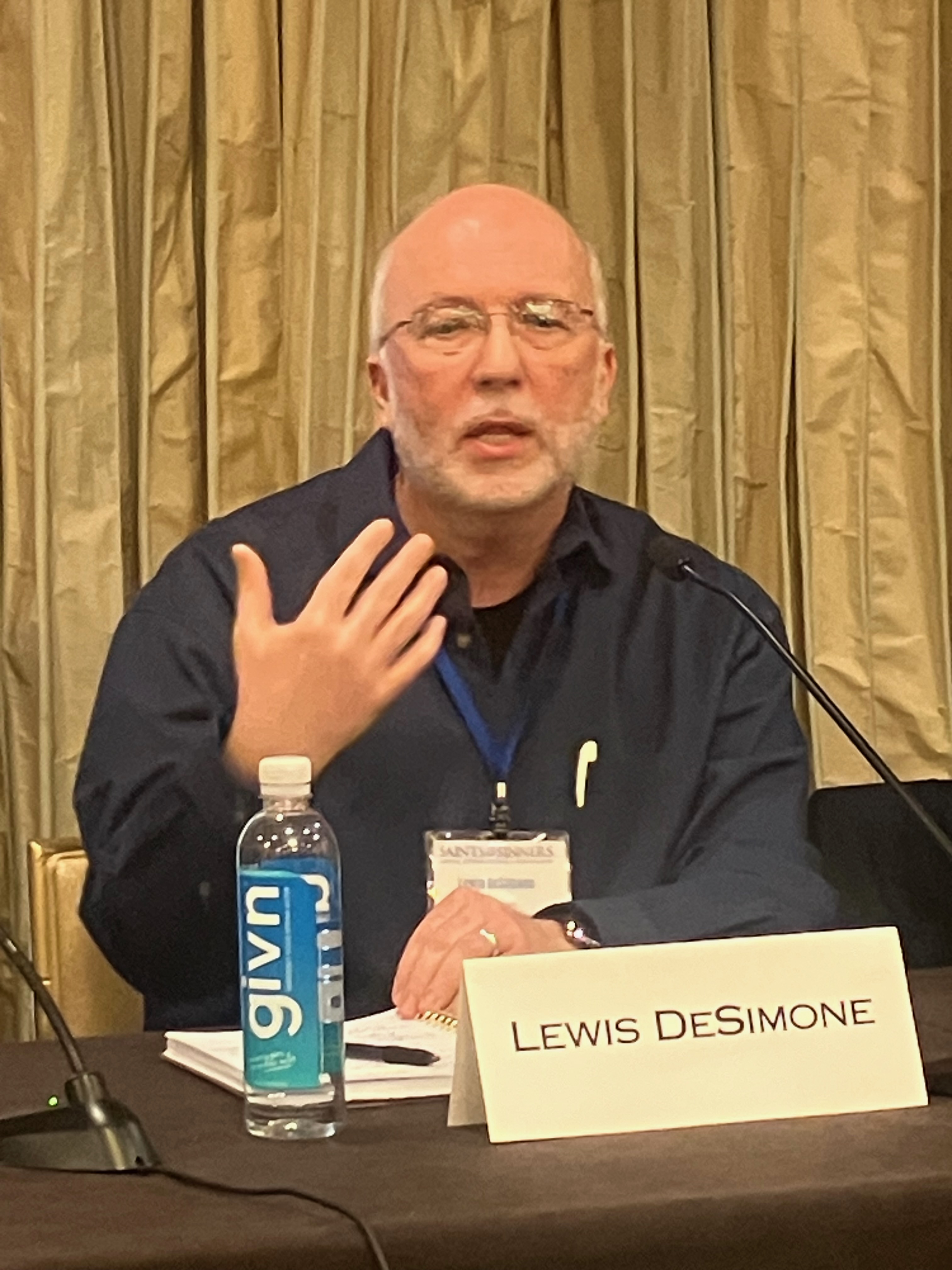
Sharing words of wisdom at the panel on Generational Change in Gay Culture and Literature
As always, the festival offered opportunities not only to reconvene with old friends but to make new ones. Writing, of course, is by definition a lonely activity, and it’s also a widely misunderstood one. That fact was underscored for me by an incident at the hotel bar the day before the festival officially began.
A few stools down from me, a thirtyish man was networking to his heart’s content, chatting up the bartender and other patrons, telling each one about his new law practice. He was looking for leads to build up his client base. When a middle-aged woman took the seat beside him, he launched into his spiel and asked what she was doing in town. She told him she was a writer attending the festival. He grew excited and took the opportunity to ask her what sort of work her attorney did for her. She laughed and said she didn’t have an attorney. This he could not fathom. “You’re a writer and you don’t have a lawyer?” “Believe me,” she said, “with the amount of money I make from my books, it wouldn’t be worth a lawyer’s time.”
The conversation encapsulated the misperceptions writers face in the world and why we need our own community for sustenance. At the festival, I was surrounded by people who got it, who understood that the majority of us will never make a living from our writing. They understood that the pleasure of creativity is our primary motivation. Some people write to make money, but the majority of us write out of love.
And for the weekend, we came together as a tribe—commiserating about our challenges, sharing tips on publishing and promotion, honoring one another’s efforts. And most of all, encouraging our peers to keep going.
I came away with a renewed commitment to my work. I even found inspiration for a major development in a piece I’ve been struggling with for ages. Such is the power of community in the creative process.
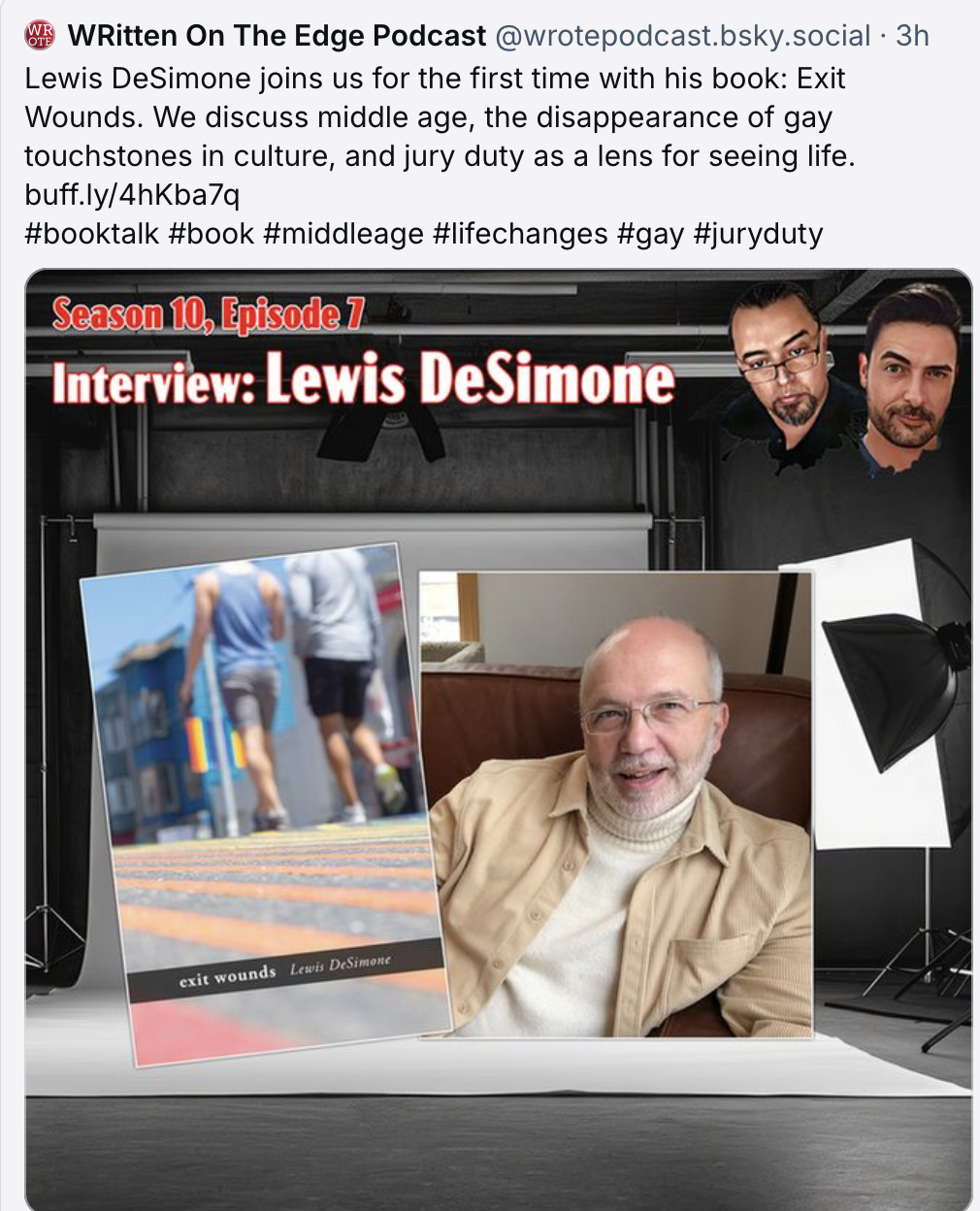
I was recently invited to the WROTE Podcast to talk about Exit Wounds. We had a fantastic conversation, ranging from what it’s like to be middle-aged in the gay community to the unexpected joys of jury duty. Take a listen and you’ll also learn who my first celebrity crush was.
Bucket lists are pretty individual things. While other people want to skydive or bungee-jump before they kick the proverbial, I’ve chosen less foolhardy things: Learn French. Visit Stonehenge. Read Finnegans Wake.
What, you say? Is it a bucket list or a self-torture device?
I’d say the same about skydiving. There’s no accounting for tastes, or definitions of foolhardy.
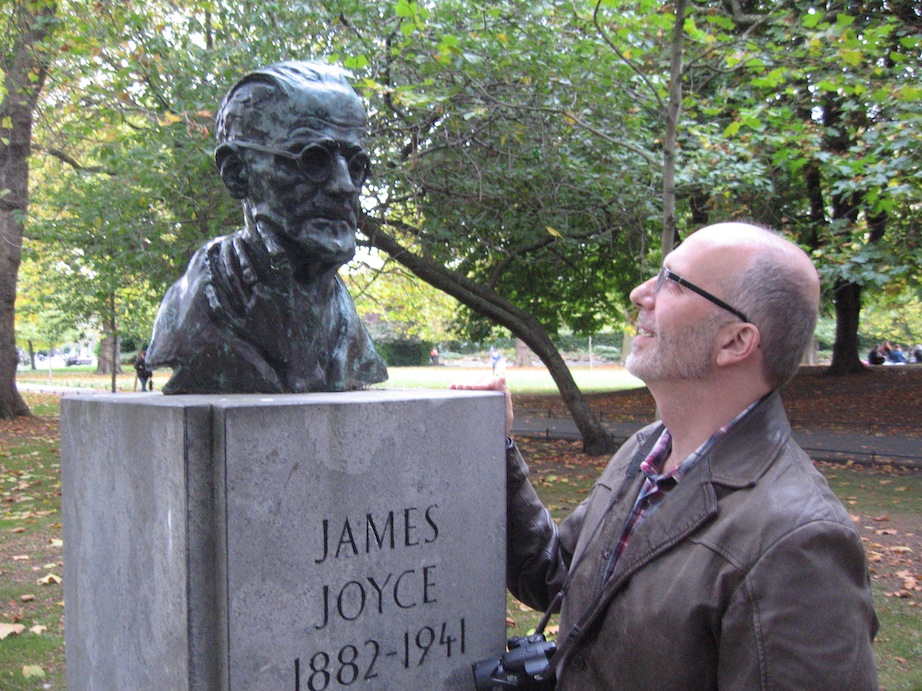
I fell in love with James Joyce way back in college, when my junior tutorial focused on Dubliners, A Portrait of the Artist as a Young Man, and Ulysses. At the time, Ulysses seemed a herculean task—and, faith and begorra, it was—but I somehow knew that my voyage into Joyceana would not be complete without reading his final book, purported to be the most difficult in the English language.
Spoiler alert: it is.
Where do I start? Perhaps in the middle of a sentence? (See below.) I’d waited years to read Finnegans Wake; only once I’d retired did I think I’d have enough free to time to give it the attention it would need. I ended up reading it fairly quickly, though—a chapter a day except for the longest couple, to which I dedicated two days each. That schedule required about two hours with the Wake per day, plus another hour for the reader’s guide by William York Tindall.
The most important decision I made was to be gentle with myself. Even Joyce scholars—including Tindall—do not claim to understand the whole thing. It’s simply too dense. Consider this: It took Joyce 17 years to write a 600-page book. That means he was writing at the rate of one-tenth of a page per day. Every word is impeccably chosen. Every word holds multiple resonances, including a plethora of delicious puns (“Ourh Former who erred in having”; “with my bawdy did I her whorsip”) and portmanteau words (“humptyhillhead”; “middayevil”). Nothing is straightforward. The language itself pulses with life in every sentence.
I chose to let the language wash over me rather than trying to pick apart every sentence. To make it easier, I found an audio version of the book and followed along with the reader—to keep me from stumbling over words and to bring the text more to life. The primary reader, Irish actor Barry McGovern, modulated his tone to represent different voices (often, there’s dialogue within a single paragraph, unmarked) and also enlivened the text with various Irish accents as appropriate. Marcella Riordan also appears in a couple of chapters, with a lively take on the female characters. I don’t know if I could have finished the book without them.
If Ulysses is the story of a single day, then Finnegans Wake is the story of a single night—most of it narrated in a dreamlike state. There are major characters—H.C. Earwicker, Anna Livia, and their children—but they tend to blend together at various times. In the end, they’re less individuals than arbitrary representatives of humanity. And the plot is ultimately unimportant. This is a story about cycles (starting with the final sentence, which merges back into the first)—wakefulness to sleep to wakefulness; life to death to life. The place where this theme resonated best for me is a sex scene in Chapter 16 (“For they met and mated and bedded and buckled and got and gave and reared and raised…”), in which the coupling of two individuals yields not just a child, but all of history; life, whether individual or communal, starts in a bed and is continually renewed there.
Throughout the book, Joyce jabs at literary history and criticism. He toys with the reader, making the text deliberately impenetrable, as though relishing the image of critics twisting themselves into pretzels trying to understand it.
I can’t say I understand the Wake, but by the end, I did feel that I “got” it. I fell into the rhythm of it, as if I were part of Earwicker’s dream. Which may be the point. One of his nicknames is Here Comes Everybody. No doubt, Joyce intended us all to see ourselves in the Wake. As a dream book, it dwells in the depths of the soul, the primordial soup of the subconscious, the foundation of humanity.
It’s also one of the funniest books I’ve ever read. The puns alone are worth its heft. In all honesty, I haven’t laughed aloud so much with a book since John Kennedy Toole’s A Confederacy of Dunces.





 Lewis DeSimone