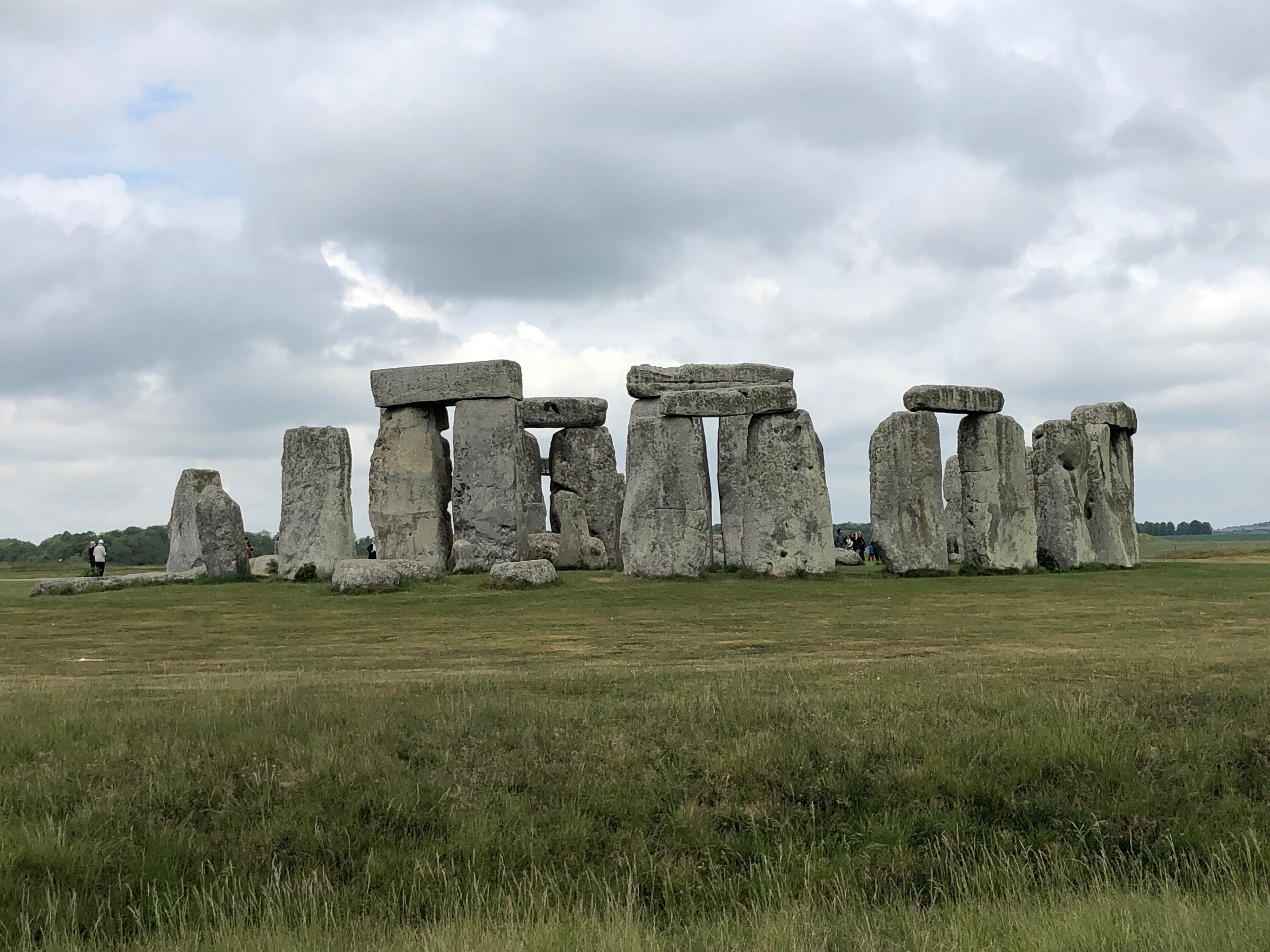
The first thing you notice about Stonehenge is its isolation. As our driver noted, warning us not to miss our scheduled departure time, the site is literally in the middle of nowhere. The visitor center, including the entrance to the site, is a 30-minute walk from the stones. When we arrived, the lot was already packed with dozens of buses, and a crush of smaller vehicles filled the car park on the other side of the road. But never fear, we were told, there were shuttles to take us directly to the stones. When we arrived, the line for the shuttle was nearly a hundred deep, but we were assured there was only a 10-minute wait. When the first one arrived several minutes later, it hardly made a dent in the line of people waiting, so we decided to forgo the bus and make our way on foot.
All would have been well if I hadn’t twisted my knee a week before and further aggravated it walking the uneven pavement in London, but I decided to “keep calm and carry on.” We proceeded along a lovely stretch of Salisbury Plain, past a number of burial mounds and a few stands of trees, before the stones came into view.
The site itself was so quiet and manageable I found myself wondering where all the people from the visitor center had gone. A rope about 20 feet from the outer ring of stones cordons off a paved path, which we followed counter-clockwise around the stones.
The quiet enhanced the otherworldly quality of the place. Though the placement of the stones has been dated to around 5,000 years ago, the means of construction and the purpose of the site are less certain. The mystery, of course, is part of the attraction. Sometimes we humans appreciate questions more than answers.
As I looked through the outer ring to the center slab, I couldn’t help thinking of Tess of the d’Urbervilles, who slept on the altar stone the night before her arrest at the end of the novel. That story has always been a favorite of mine, key to my senior thesis in college. Whatever the original use of Stonehenge, Hardy placed his heroine here to identify her as a sacrificial lamb, an innocent corrupted and ultimately destroyed by a world that valued her for her beauty alone and punished her for wanting to be more.
That moment alone makes the site sacred to me. Literature, after all, is my religion, its characters my patron saints. And the trip to Stonehenge, on my bucket list for years, was a pilgrimage. Unfortunately, it’s not Lourdes; it didn’t heal my knee. But for half an hour, circling the stones, marveling at the achievement of an ancient, unknown people, I didn’t feel the pain at all.
 Lewis DeSimone